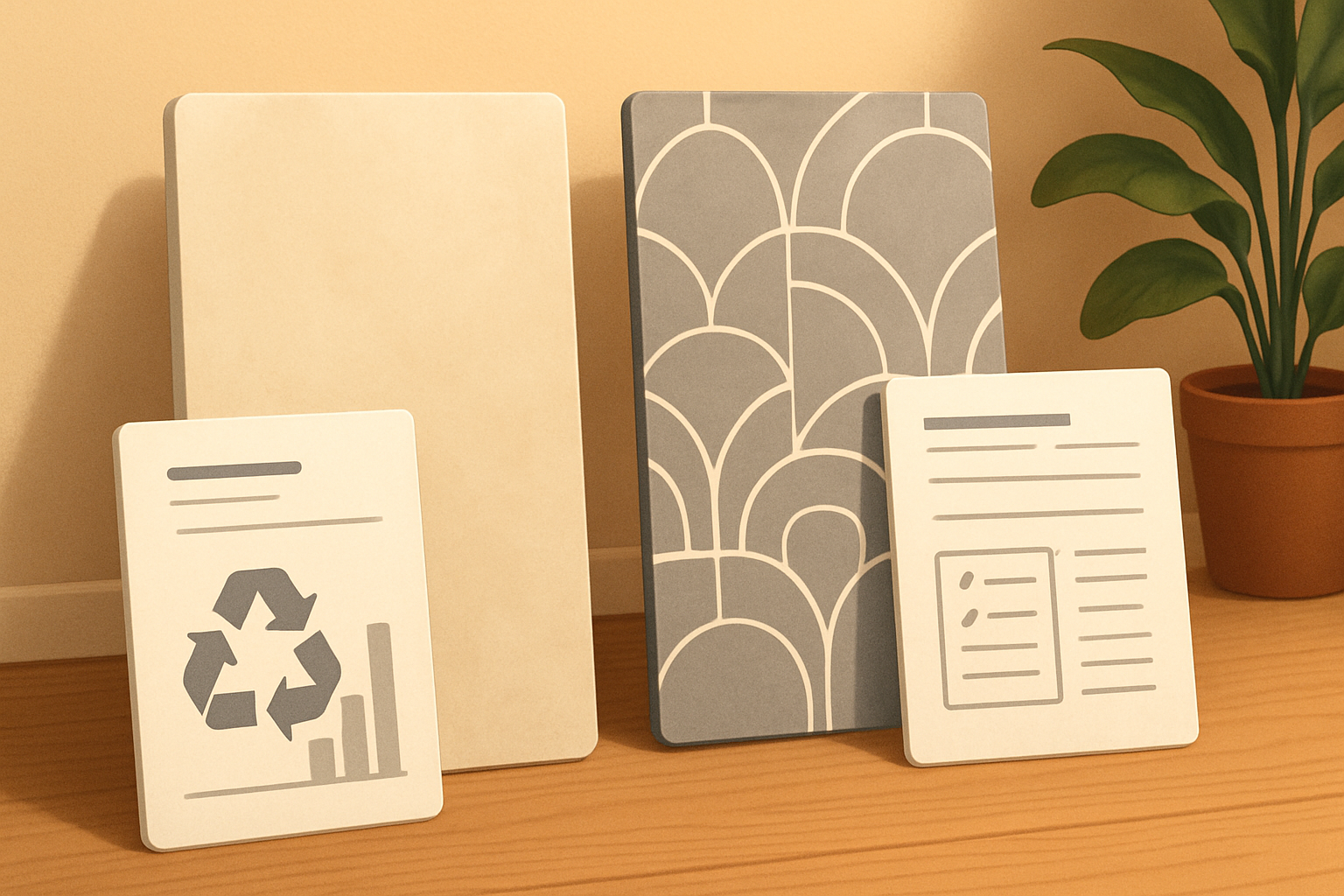
Two tile products can look nearly identical on a showroom board and still leave very different environmental footprints once you check the paperwork behind them. For Colorado Springs remodelers trying to choose sustainable tile flooring, the real question is not which color looks more natural. It is which product can prove recycled content, show product-level environmental data, travel a reasonable distance, and stay in service long enough that you are not tearing it out in 7 years because the wrong tile was chosen for the room.
You can tell whether a tile product is a more sustainable choice by checking documented facts, not green-sounding labels. Compare product-level recycled content, manufacturer environmental declarations, expected service life, shipping distance, and whether the tile is likely to stay installed for decades in your actual room and household.
I have been in flooring a long time, and this is one of the places buyers get talked into a story instead of shown evidence. If two tiles cost about the same and look about the same, I want to know what I can verify on the exact SKU, not what somebody says about the brand in general.
How can I tell whether a tile product is a more sustainable choice?
Start with a short evidence checklist. A more sustainable tile product is the one that can document lower-impact inputs and is more likely to avoid early replacement in your home. That means the best answer usually comes from 5 questions, not 1 label.
A practical checklist for sustainable tile flooring
- Is recycled content stated for this exact product? Ask for the percentage and whether it is pre-consumer, post-consumer, or both.
- Is there a product-specific environmental declaration? Look for an Environmental Product Declaration, often called an EPD, or other manufacturer documentation tied to the exact tile line.
- Where was it manufactured, and how far is it traveling? Shipping matters, but only when you know where the tile was actually made. Do not assume a tile sold in Colorado was made nearby.
- What is the expected service life in this room? A tile that stays put for 20 to 30 years is usually a stronger sustainability choice than one replaced after 8 to 10.
- Can the installation stay, instead of being redone because of a bad fit for kids, dogs, snowmelt, or heavy traffic? Durability in the real household matters more than eco packaging.
- Is the order quantity tight enough to avoid unnecessary waste, but realistic enough to handle cuts, pattern matching, and attic-stock repairs later?
The U.S. Environmental Protection Agency puts source reduction first in its materials management hierarchy. In plain English, the greenest material is often the one you do not have to replace early. That is why longevity belongs near the top of any sustainable tile flooring checklist.
Which claims can actually be documented on a tile product?
The strongest claims are the ones tied to the exact product you are buying, not broad promises about a manufacturer. If a claim cannot be traced to a SKU, treat it as marketing until proven otherwise.
Here is the weak version versus the strong version.
| Claim type | Weaker | Stronger |
|---|---|---|
| Recycled content | "Our tile contains recycled material." | "This 12 by 24 field tile contains 28 percent pre-consumer recycled content, documented on the product data sheet." |
| Environmental reporting | "This brand is eco-friendly." | "This tile line has an EPD and a third-party certification listed for the exact series." |
| Origin | "It is available locally." | "It is manufactured in State X or Country Y, then shipped to Colorado." |
| Longevity | "It is durable." | "It is rated for the intended floor application and expected to hold up in a busy kitchen with pets and kids." |
Center for Climate and Energy Solutions notes that Environmental Product Declarations are used to report lifecycle data in a standardized format. An EPD does not automatically make one tile better than another, but it gives you a factual basis for comparison. No document, no proof.
Common mistake: treating brand-level sustainability language as product proof
A manufacturer may publish a good sustainability statement and still have wide differences between product lines. One tile might include 30 percent recycled material and another from the same company might include none. Ask for documentation on the exact tile, not the company brochure.
What counts as product-level documentation?
Look for a product data sheet, technical data sheet, EPD, or manufacturer declaration tied to the line and SKU. If the salesperson cannot match the claim to the exact item, keep asking.
Do I need third-party documentation?
Third-party documentation is better when available because it reduces self-reporting bias. Still, a manufacturer product sheet tied to the actual tile is more useful than a vague eco claim with no paperwork at all.
Why does longevity matter as much as recycled content?
Longevity matters because replacement has its own environmental cost. Pulling out tile means new material, packaging, shipping, demolition waste, and another installation cycle. A tile that truly fits the room can be the more sustainable choice even if its recycled-content number is not the highest on paper.
In a Colorado Springs kitchen, for example, you might have 2 adults, 2 kids, 1 large dog, and regular traffic from the garage entry with snowmelt, grit, and winter salt. In that house, the wrong glossy kitchen tile can become a regret fast. The better sustainability move is the product you will keep for 20 years because it works, not the product you replace after 6 because it looked better on a sample board.
Local conditions change the math. In Colorado Springs, Fountain, Falcon, and Monument, we see dry air, big sun exposure, tracked-in grit, and winter moisture at entries. Those conditions do not make a tile unsustainable by themselves, but they do make bad product selection more likely to lead to early replacement.
I tell families this all the time. A floor does not become sustainable because the brochure uses a leaf icon. It becomes sustainable when it survives real life and stays in place.
How long should I expect a tile floor to last?
Many tile installations can last for decades if the product is right for the use and the subfloor and installation are handled correctly. Service life varies, but a 20 to 30 year horizon is a useful way to think about a kitchen or bath floor instead of a 5 to 10 year decorating cycle.
What about bathrooms?
In a Colorado Springs bath remodel, the more sustainable choice is often the tile that handles constant cleaning, family traffic, and wet use without making you want to rip it out for performance reasons. That is why room fit matters more than trend fit.
If you are still narrowing down room use, budget, and installation realities, our breakdown of tile flooring costs, what to expect, and how to choose in Colorado Springs helps connect showroom samples to real project decisions.
How much does transportation matter for Colorado Springs remodelers?
Transportation matters, but only after you know where the tile was manufactured and how it is getting here. A tile stocked by a local seller may still be made across the country or overseas. Local availability helps lead time and support, but it is not proof of local manufacturing.
For a practical comparison, imagine 2 similar 12 by 24 matte tiles for a 90 square foot bathroom floor and tub surround. Tile A has 22 percent recycled content, an EPD, and is manufactured in the United States. Tile B has no recycled-content documentation, no product declaration, and is imported. You may still choose Tile B if it is the only product that truly fits the room, but now you know what tradeoff you are making.
The U.S. Department of Energy has long identified transportation as a meaningful contributor to product-related emissions. For remodel buyers, that means distance belongs on the list, just not at the expense of service life or verified data.
Should I automatically buy the closest option?
No. A closer product with no documentation and a short useful life can be a worse choice than a farther product with solid documentation and a long expected service life. Distance is one factor, not the whole decision.
Myth: If a tile is sold in Colorado Springs, it is basically a local product and therefore the greener choice.
Reality: Sold locally and manufactured locally are not the same thing. Ask where the product was made, whether that origin is documented, and whether the product has the service life to justify the shipping it took to get here.
How do I reduce avoidable waste when ordering tile?
Waste control starts before the order is placed. Good measurement, layout planning, and disciplined overage reduce both shortages and excess. You are trying to avoid 2 expensive mistakes at once, coming up short and overbuying badly.
- Measure the actual room carefully. Include closets, toilet alcoves, tub fronts, and transitions.
- Account for pattern and tile size. Straight lay and larger formats usually waste less than diagonal layouts or complex patterns.
- Order appropriate overage. A common range is about 10 percent for straightforward rooms and 12 to 15 percent for more cuts, offsets, or future repair stock.
- Confirm dye lot and caliber. Reordering later may not match exactly.
- Plan transitions before ordering. Extra waste often comes from late changes at doorways, islands, or mixed-floor areas.
A 120 square foot bathroom might need roughly 132 square feet of tile at 10 percent overage, or closer to 138 square feet at 15 percent if the layout is fussy. That difference sounds small until it is repeated across floor tile, shower tile, trim pieces, and accent material.
That is one reason we push accurate measurement early. Our article on transition planning before you order materials gets into one of the biggest sources of avoidable waste in remodels. And if installation day logistics are part of your stress list, this guide on whether you have to move furniture before new flooring is installed can help you plan the room better from the start.
What does this checklist look like in a hypothetical Colorado Springs remodel?
Apply the same 5 evidence points to actual products in an actual room. That is how you move from eco language to a real buying decision.
Say a family in Briargate is remodeling a 110 square foot hall bath and considering 2 similar gray floor tiles.
- Tile 1: 24 percent recycled content documented on the product sheet. EPD available. Manufactured in the U.S. Lead time 2 weeks. Appropriate for floor use. Price difference, $1.75 more per square foot.
- Tile 2: No recycled-content percentage provided. No EPD located. Imported. Lead time 6 to 8 weeks. Appropriate for floor use. Lower material price.
Now add project reality. The house has 3 kids, 1 dog, and a busy morning routine. The family wants a floor they can keep a long time and they do not want a reorder problem if one box arrives damaged. In that case, Tile 1 has the stronger sustainability profile because it offers 3 things Tile 2 does not: documented material inputs, better traceability, and a shorter supply chain risk if replacement cartons are needed.
Would I still check installed price per square foot, warranty terms, and lead time? Absolutely. Buyers should always look at the whole job, not just the carton label. The same common-sense buyer work applies across categories, which is why we also tell shoppers comparing other materials to look at the full installed picture in guides like how to read an LVP warranty like an owner.
"A sustainable product is one you can document, one that fits the room, and one you are not replacing early because somebody sold you on a story instead of the facts." John Hughes
John Hughes's Insights
I have watched a lot of remodels go sideways because the buyer was handed broad claims and never got the specifics. My rule is simple. Slow down long enough to verify the exact tile. Ask what it is made of, where it is made, what paperwork exists for that line, and how likely it is to stay on your floor for the next couple of decades. If a seller gets annoyed by those questions, that tells you something. Around Colorado Springs, I also want people thinking about the real house, not the showroom vignette. Dogs, kids, grit at the back door, hard use in a hall bath, all of that counts. A greener choice on paper stops being green the minute it has to be replaced too soon.
Need help comparing tile products the right way?
We can take this exact job off your plate. Bring in the tile names you are considering, or schedule a free in-home measure, and we will help you compare documentation, ordering quantities, transitions, and long-term fit for your Colorado Springs remodel. If you want sustainable tile flooring without guesswork, start with a local team that will look at the evidence with you.
Book your free in-home flooring measure and consultationExplore more, or reach out directly to O'Briens Carpet One Floor & Home in Colorado Springs, CO.