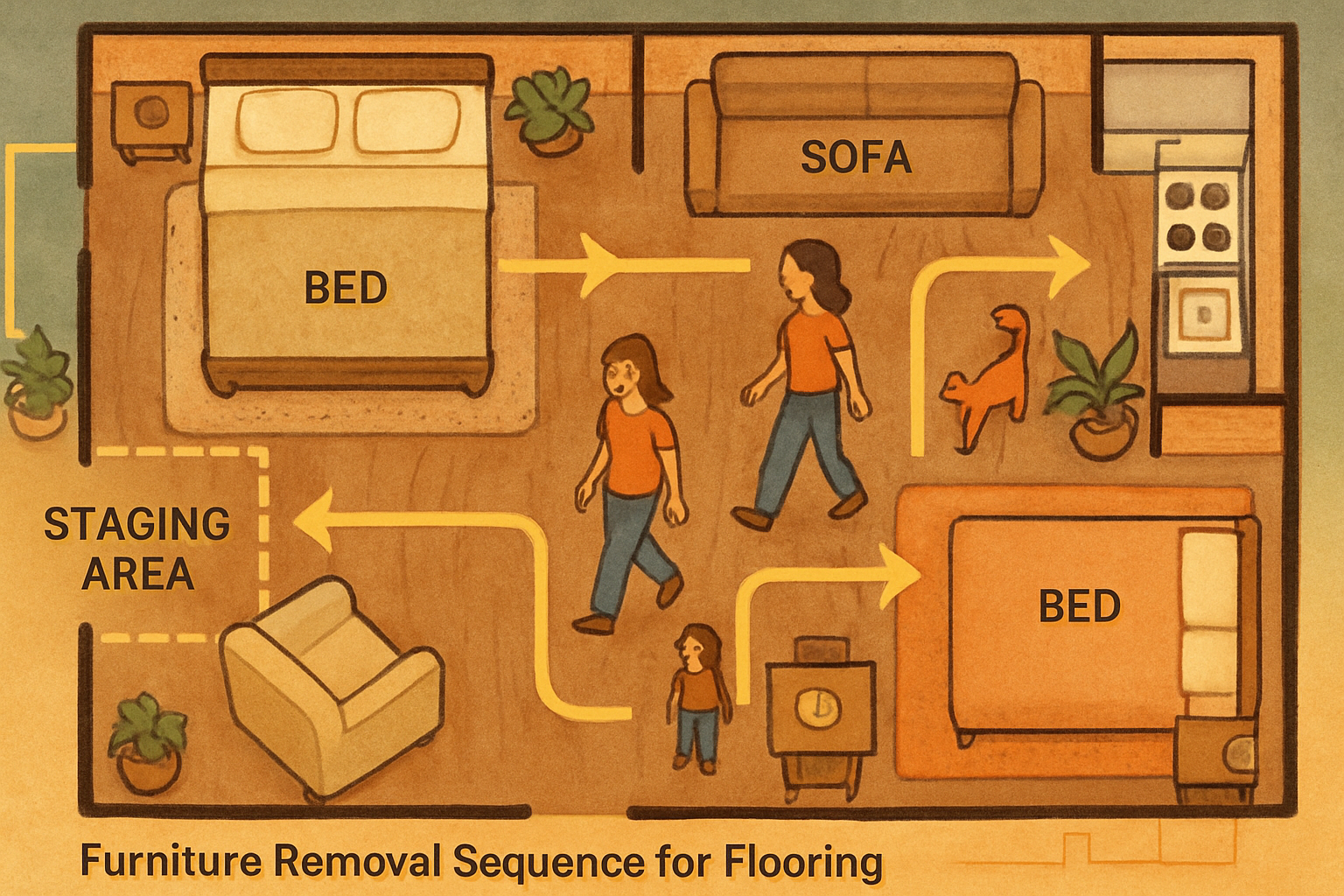
A flooring crew can install fast in an empty room. The same job slows down quickly if every bed, sofa, TV stand, and refrigerator has to be worked around inside a lived-in house. That is why homeowners in Colorado Springs who are close to scheduling often ask the same practical question: do I need to move furniture for flooring installation, or will the installers handle it?
Usually, yes. Homeowners often need to move at least some furniture before new flooring is installed, unless the written project scope clearly says the installer will move specific items. Furniture planning matters because it affects labor, room access, job sequencing, and how many days the installation crew needs inside an occupied home.
Do homeowners need to move their furniture before new flooring is installed?
Yes, in many cases they do, but the real answer depends on what your installer has agreed to move, what items are in the home, and whether the work is happening in one empty room or across several occupied rooms. If that responsibility is not spelled out in writing, installation day can start with confusion instead of progress.
I have been in flooring a long time, and this is one of the biggest schedule changers I see. Folks spend weeks picking carpet, hardwood, laminate, tile, or LVP, then assume the room-prep part will sort itself out. It rarely does.
An empty room gives the crew clear access to:
- Remove old flooring
- Prep the subfloor
- Bring in materials and tools
- Install the new floor without stopping to shift contents around
- Keep the job moving on the expected timeline
A furnished room creates a different job. Now the crew may need to stage furniture into an adjacent room, hallway, garage, or one side of the space, install in sections, then move pieces back. That adds labor, adds time, and can limit how many rooms can be worked on in a day.
The phrase do I need to move furniture for flooring installation comes up so often because people are really asking a scheduling question. They want to know how disruptive this will be in a house where people still need to sleep, cook, work, and get kids out the door.
Why does furniture planning change labor, sequencing, access, and the installation schedule?
Furniture planning changes the job because a crew can work continuously in an empty room, while a furnished room requires stop-and-start staging. That affects labor hours, the order rooms are installed, where materials can be set, and whether the crew can finish in one visit or needs extra time.
Here is the simplest comparison.
| Job Condition | What the Crew Can Do | Likely Schedule Effect |
|---|---|---|
| Empty room | Start immediately, remove old floor, prep, install, clean up | Fastest workflow, fewer interruptions |
| Furnished room, light contents | Shift chairs, small tables, some boxed items | Moderate delay, added labor |
| Furnished room, heavy or oversized contents | Stage large items in phases, pause install, return items later | Longest workflow, more coordination |
Strong planning sounds like this: “Guest room will be emptied by homeowner the night before. Main bedroom furniture will be moved by homeowner except king bed frame, which installer will move if scope allows. Office electronics and monitors will be disconnected by homeowner.”
Weak planning sounds like this: “We will just move stuff around as needed.”
The weak version is where schedules slip.
In Colorado Springs, this matters even more in multiroom jobs because people are often living through the remodel during school weeks, snow season, or summer moves. A crew cannot use a dining room as a staging area if that room is also full of boxes from two other spaces. If the garage is packed, there may be nowhere temporary to place contents at all.
I tell customers this plainly. A furnished three-room project is not the same job as three empty rooms, even with the same flooring product.
In Colorado Springs and El Paso County, entry areas often carry in snowmelt, gravel, and de-icing residue during winter and early spring. If installers are working in an occupied home in neighborhoods from Briargate to Fountain, keeping clear access paths matters even more because traffic through the house is already harder to manage in wet or icy weather.
What items should be confirmed in the written project scope before installation day?
The written scope should name exactly who is responsible for furniture, appliances, electronics, beds, fragile objects, and oversized pieces. Policies vary by company, by product type, and by room condition, so verbal assumptions are not enough.
This is the heart of the responsibility map. Do not settle for “furniture moving included” unless you know what that means in your house.
Ask for each of these categories to be addressed:
- Standard furniture. Sofas, dining chairs, end tables, dressers, coffee tables
- Beds. Twin, queen, king mattresses, adjustable bases, platform frames, bunk beds
- Appliances. Refrigerators, ranges, washers, dryers, wine fridges
- Electronics. TVs, sound bars, desktop computers, printers, gaming systems
- Fragile objects. Lamps, framed art, mirrors, glass shelves, collectibles
- Oversized pieces. Pool tables, pianos, safes, aquariums, large sectionals
- Closet contents. Shoes, hanging clothes, storage bins
- Breakables and valuables. Jewelry, medication, important papers
Some installers will move basic furniture. Some will not move anything. Some will move furniture but not disconnect electronics or gas appliances. Some will move a standard bed but not an adjustable base. Those differences need to be in writing.
The Occupational Safety and Health Administration sets workplace safety guidance around lifting, handling, and jobsite hazards. That is part of why many flooring companies place limits on what crews will move, especially with very heavy items, appliances, or anything fragile and high-risk.
Pre-installation responsibility checklist
- List every room being installed, 1 by 1
- Mark whether each room will be empty, partially furnished, or occupied during the work
- Name who moves furniture in each room
- Confirm who disconnects and reconnects electronics
- Confirm appliance policy, including refrigerators and laundry machines
- Identify pieces that require a specialty mover
- Remove fragile objects before the crew arrives
- Ask where staged furniture can go during the project
How does staged furniture movement work in a lived-in multiroom remodel?
Staged furniture movement means contents are relocated in phases so the crew can keep working through an occupied home. It can work well, but it requires a room order, temporary holding areas, and realistic expectations about what spaces will be usable each day.
Here is a Colorado Springs example that is close to what many remodelers face.
A family in the north side of Colorado Springs schedules new flooring in the living room, hallway, three bedrooms, and a home office. Two adults are working from home. Two kids are still in school. A dog crate, desks, dressers, and one king bed are staying in the house. The project is not just about laying flooring. It is about keeping the house functional for 2 to 4 days, sometimes longer depending on the rooms and products involved.
A staged plan might look like this:
- Day 1. Homeowner clears office electronics, closet contents, lamps, and wall decor. Crew starts in two emptied bedrooms.
- Day 2. Furniture from the home office is staged into finished bedrooms. Office flooring is installed.
- Day 3. Living room furniture is condensed and shifted in sections, or temporarily relocated to finished rooms or garage space if available.
- Day 4. Hallway and final resets, depending on access and product requirements.
That is very different from a vacant property where all 5 spaces are open on day one.
If the homeowners have not planned where 3 desks, 2 dressers, 1 sectional, 4 nightstands, and a king bed will go, the crew loses time before the first plank or carpet strip goes down. A simple staging decision can affect whether the installer gets 8 productive hours or 5.
I have seen a house lose half a morning because nobody decided where the office monitors and file cabinets were going. It sounds small until a full crew is waiting.
If you are considering luxury vinyl in a busy family home, our guide on LVP flooring costs and what to expect in Colorado Springs helps with product-side planning, and our article on reading the LVP warranty like an owner explains why installation conditions and use matter after the floor is in.
"The customer always comes first, but the schedule still has to match the reality inside the house. A lived-in home needs a room plan, not a guess." , John Hughes
What should homeowners remove themselves before the crew arrives?
Homeowners should usually remove fragile items, personal belongings, closet contents when affected, small electronics, and anything the crew should not be asked to handle. Even if furniture moving is included, installers generally are not the right people to pack your home.
Most occupied-home prep lists include these homeowner tasks:
- Take down wall art, mirrors, and breakables in active work areas
- Disconnect computers, printers, game systems, and entertainment devices
- Clear bookshelves, low cabinets, and closet floors if those areas are affected
- Pack lamps, ceramics, glass decor, and family photos
- Secure pets and pet supplies away from the work zone
- Remove valuables, medication, keys, and important documents
If odors, pet damage, or deep contamination are part of the reason you are replacing floors, our article on controlling pet odors before you replace your floors can help you decide what should be addressed before installation begins.
For hardwood buyers, especially in active family homes, the prep conversation often happens alongside durability questions. Our piece on hardwood that ages gracefully in Colorado Springs homes is useful if your remodel includes dogs, kids, or heavy traffic.
How early should you settle the question, do I need to move furniture for flooring installation?
You should settle it before the install date is locked, not the day before. That gives everyone time to plan labor, decide room order, arrange extra help if needed, and avoid preventable delays inside an occupied house.
A good target is at least 7 to 10 days before installation, and earlier for multiroom projects, heavy furniture, or appliance-heavy spaces like kitchens and laundry rooms. If you wait until the final 24 to 48 hours, your options get tighter.
That early decision helps answer practical questions such as:
- Will anyone need temporary sleeping space?
- Can the office be offline for a day?
- Is the garage available for staging?
- Do oversized items need a specialty mover?
- Will older appliances need separate service calls?
The National Association of Home Builders regularly tracks remodeling demand and homeowner project activity. The broader point is simple. Busy households often stack trades, deliveries, and family schedules on top of one another. Flooring work goes better when the contents plan is set early and written down.
If you are still comparing products, our overview of vinyl flooring costs and what to expect in Colorado Springs can help you narrow the product side while you sort out room logistics.
Frequently Asked Questions
Will installers move my refrigerator, washer, or dryer?
Sometimes, but never assume it. Appliance policies vary, and some crews will not disconnect water, gas, or electrical hookups. Confirm in writing whether appliances are being moved, who disconnects them, and whether they will be put back in place the same day.
Do I have to leave the house during flooring installation?
Not always. Many Colorado Springs homeowners stay in the home during installation, especially in phased multiroom work. The real issue is access and daily function. You may need to avoid certain rooms for 1 day, 2 days, or longer depending on the rooms involved, furniture staging, and the flooring product being installed.
See how we map room prep before installation day
If you are still asking, do I need to move furniture for flooring installation, the best next step is to get the answer room by room and in writing. At O'Briens Carpet One Floor & Home, we help Colorado Springs homeowners spell out who moves what, how staged rooms will work, and what that means for the installation schedule in an occupied home.
Book your free in-home flooring measure and consultation at O'Briens Carpet One Floor & Home