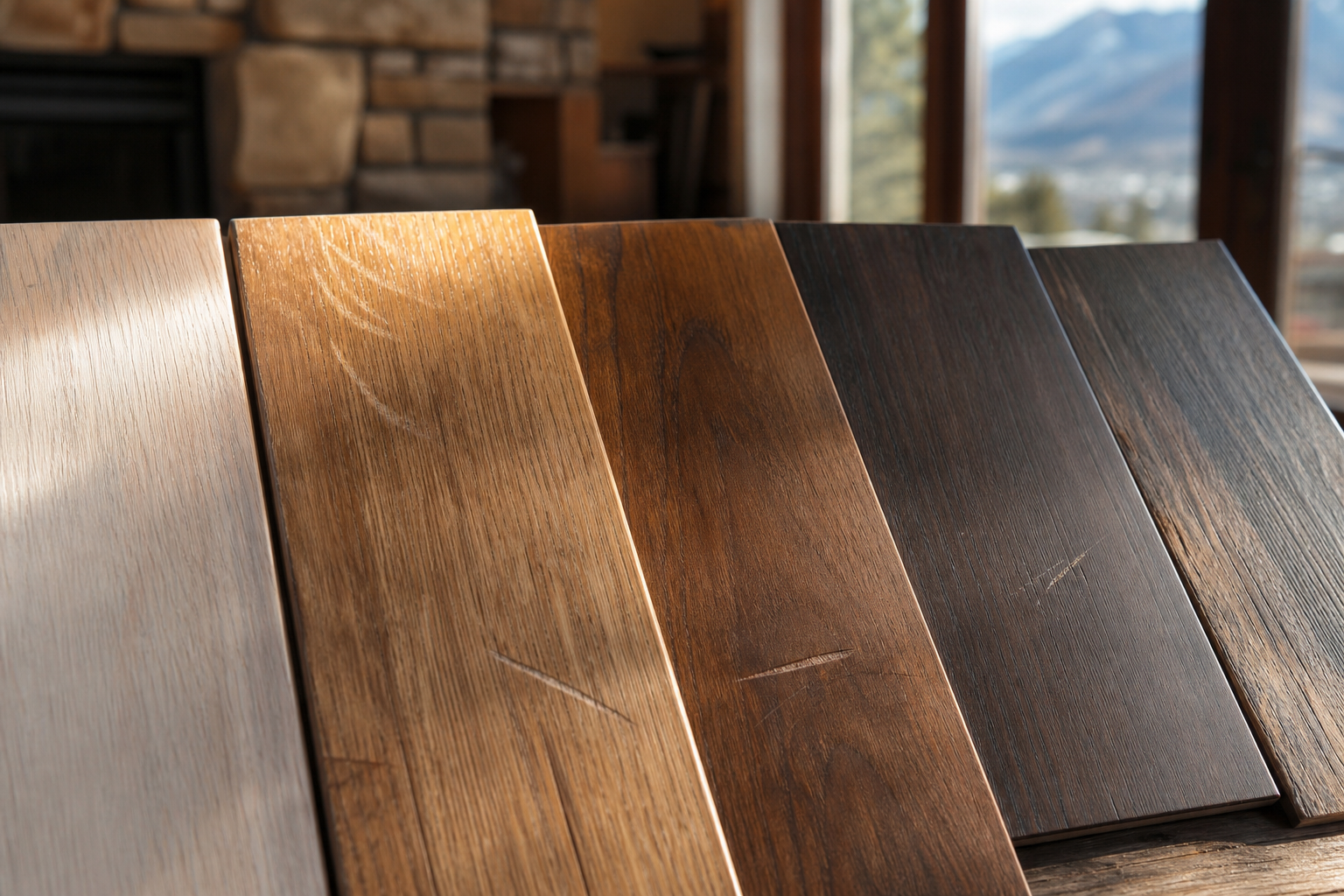
Picture your hardwood floor 3 years from now, not 3 minutes after installation. In a Colorado Springs family home, that means backpack buckles dropped by the entry, toy bins dragged across the living room, chair legs scooting at dinner, and a dog cutting the corner at full speed. The real question is not how to keep every mark from happening. It is how to choose hardwood that hides scratches Colorado Springs families can still enjoy after ordinary life shows up.
Scratches and dents are less noticeable on hardwood floors when the floor has lower color contrast, visible grain, natural variation, and some surface texture that breaks up light. Medium tones usually show daily wear less than very dark or very light boards. The best sample is not the one that looks most perfect in the showroom. It is the one that still looks good in your house after you imagine several years of normal traffic.
What makes scratches and dents less noticeable on hardwood floors?
Scratches and dents stand out less when the floor does not create a sharp visual spotlight around them. Marks catch your eye most on smooth, uniform, high-contrast surfaces. They fade into the background more on boards with color movement, grain activity, and a texture that scatters light instead of reflecting it like a sheet of glass.
That is the heart of the decision for active families. A floor can be perfectly good hardwood and still be a poor visual match for a house with kids, pets, lunchboxes, and constant chair movement.
Here are the 5 appearance traits that matter most:
- Color contrast. If a scratch reveals a lighter or darker line against the surrounding color, you will notice it faster.
- Grain visibility. Stronger grain patterns help disguise small linear marks because the eye is already reading movement in the board.
- Surface texture. A little texture can soften reflected light and reduce how sharply wear reads from standing height.
- Natural variation from board to board. Floors with tone shifts and character tend to camouflage everyday marks better than very uniform selections.
- Your tolerance for patina. Some homeowners enjoy a lived-in floor. Others want it to look nearly untouched. That preference should guide the purchase.
I tell families this all the time in our showroom. If you pick a floor that asks your household to behave differently every day, the floor usually loses.
Colorado Springs adds its own wear pattern. Snowmelt, grit, and deicing residue at entryways in winter, dry air most of the year, and strong sun at altitude can all change how a floor reads over time. A sample that looks calm under showroom lighting can look much busier near a bright south-facing patio door in Briargate, Flying Horse, or Fountain.
Why do some hardwood scratches jump out while others seem to disappear?
Scratches jump out when light, color, and uniformity all work against you. They seem to disappear when the floor already contains enough visual information that a small mark does not become the most noticeable line in the room.
Think about a busy family room with toys, a sectional, dog bowls, and sunlight crossing the floor by 4 p.m. A tiny scratch on a highly uniform dark board can read like a bright pencil line. The same scratch on a medium-toned board with visible grain and color movement may be hard to spot unless you are down on your hands and knees.
A useful way to judge this is to ask, “What is my eye seeing first?”
- If the answer is “every board looks exactly the same,” small defects tend to stand out.
- If the answer is “I see grain, tone variation, and texture,” ordinary wear blends more easily.
That is not just opinion. The U.S. Forest Service has long documented how wood’s natural grain, figure, and color variation affect visual character. In plain language, more natural character gives the eye more to read than a single little mark.
Which hardwood appearance usually ages best for active Colorado Springs families?
Medium tones with visible grain, moderate variation, and a less mirror-like surface usually age more gracefully in active homes. They are not magic. They simply tend to make normal wear less obvious day to day.
That does not mean every family should buy the exact same look. It means the visual sweet spot is often somewhere between “very dark and very uniform” and “very pale and very flat.”
| Appearance choice | How ordinary wear tends to read | Why |
|---|---|---|
| Very dark, very uniform | Marks often show quickly | High contrast and reflected light make scratches easier to spot |
| Very light, very uniform | Dents and dirt lines may read clearly | Low variation gives the eye fewer distractions |
| Medium tone, visible grain | Daily wear is often less noticeable | Balanced color and grain help break up minor marks |
| Character-rich, varied boards | Small scratches often blend better | Natural movement and tonal shifts reduce visual contrast |
For a household with 2 kids, 1 or 2 dogs, kitchen stools, and constant in-and-out traffic, this is usually where the conversation should start. Not “What is the toughest possible board?” but “What will still look satisfying after 5 winters, 7 birthday parties, and 10,000 chair scoots?”
If your family is also comparing wood looks with other categories, our articles on LVP flooring costs and what to expect in Colorado Springs and what makes luxury vinyl plank look more like real wood can help you sort out appearance versus wear expectations before you buy.
The most common sample mistake
Homeowners often choose the sample that looks the cleanest and most uniform in a small showroom piece. That can be the exact appearance that becomes frustrating fastest in a real family home. A small perfect sample does not show how repeated small marks will read across 300, 700, or 1,200 square feet.
How should you test a hardwood sample at home before you decide?
Test it in your actual light, at your actual viewing distance, and in the parts of the house that take real traffic. A hardwood sample should survive your imagination before it earns your money.
Use this 6-step sample exercise:
- Bring home larger samples, not tiny chips. Bigger pieces reveal grain, variation, and reflectivity more honestly.
- View them in morning, midday, and evening light for at least 2 days.
- Set one sample by the main entry and one near the busiest seating area.
- Look at them standing up from 6 to 10 feet away, not only from arm’s length.
- Place a backpack, pet bowl, dining chair, and toy basket nearby. Picture how those objects interact with the floor every week.
- Ask yourself which sample still looks good after you mentally add 3 years of ordinary use.
The National Wood Flooring Association, at woodfloors.org, emphasizes evaluating wood as a natural material with inherent variation. I agree with that, but I would add one thing from the sales floor. Variation only helps if you actually like it. If you want a crisp, uniform appearance, be honest that you may also notice wear more.
Does family traffic change where wear becomes visible first?
Yes. Wear shows first where motion repeats in the same path and where objects meet the floor at sharp angles. In family homes, that is usually not the middle of the room. It is the route patterns.
In many Colorado Springs homes, the first places I would study are:
- The front entry where grit and moisture come in
- The kitchen work triangle
- Under dining chairs
- The hall between bedrooms and bath
- The turn where a dog launches into the living room
- The drop zone near hooks, cubbies, or the mudroom bench
According to the U.S. Census Bureau, about 30.2% of Colorado Springs households had children under 18 in recent American Community Survey estimates. That is a lot of homes making flooring decisions around real family traffic, not showroom traffic.
Myth: If a hardwood sample looks pristine and elegant in the store, it will keep that look best in a busy house.
Reality: Pristine showroom beauty and graceful aging are not the same thing. The samples that age best visually are often the ones with enough grain, tone movement, and texture to soften normal wear after years of backpacks, toys, pets, and chair movement.
How much does your own tolerance for patina matter?
Your tolerance for patina matters as much as the floor itself. Two families can look at the same 4-year-old hardwood floor and have completely different reactions. One sees character. The other sees damage.
This is the part people skip because it feels less technical. It is actually one of the most important decisions in the whole process.
Try this simple test:
- If a few small dents make you think “that floor is living well,” you can choose a wider range of wood looks.
- If a single visible scratch will bother you every morning, you need to choose an appearance that masks contrast better from the start.
There is no wrong answer. There is only the wrong match.
Weak approach: “We want the cleanest, smoothest, darkest sample because it looks expensive.”
Stronger approach: “We want hardwood that hides scratches Colorado Springs families can live on daily, and we want to like how it looks after several years of chairs, pets, and kid traffic.”
That second statement usually leads to a better purchase.
Sample checklist for a family home
- Do I see strong contrast if a thin line appears on this color?
- Does the grain help break up small marks visually?
- Is the surface reflective enough that every scuff may catch window light?
- Does the floor have enough variation that a future dent will not become the focal point?
- Would I still like this floor if it developed mild patina in 2 to 4 years?
John Hughes's Insights
I have been doing this work for more than 40 years, and I have a big family myself, so I do not sell hardwood based on a perfect board under perfect lights. I try to help people picture Saturday morning. Shoes by the door. A dog coming in hot. A chair getting pushed back 20 times. Kids dropping things because kids drop things. If you start there, you usually make a better choice.
Some homeowners want a floor that stays very formal-looking. That is fine, but I will tell them straight that active family life may show up faster on certain looks. Other families are comfortable with a little patina and want warmth more than perfection. That is often where hardwood becomes enjoyable instead of stressful.
What should Colorado Springs families compare before they visit a showroom?
Compare not just species names or brand names, but the visual traits that control how wear will read in your own rooms. If you walk into 2 or 3 local showrooms with that filter, the options get clearer fast.
Before you visit, make a short list of the rooms, the traffic pattern, and the look you can live with after years of use. Bring a few phone photos of your light conditions too. In homes around Monument, Falcon, and Security-Widefield, I often see buyers surprised by how much daylight changes the apparent color and contrast of a floor.
As you narrow choices, it also helps to know what happens after selection. Our article on what happens during a professional flooring measure explains the room-by-room process, and if your project includes adjoining materials, transition planning in open floor plans is worth reading before materials are ordered.
Most people do not need more choices. They need a better way to eliminate the wrong ones. For many families searching for hardwood that hides scratches Colorado Springs homes tend to demand, that filter is appearance under future wear, not first-day perfection.
"The best hardwood sample for a busy family is usually not the one that looks the most flawless today. It is the one that still feels right after you picture real life on it." , John Hughes
Need help judging how a hardwood sample will really age?
If sorting through samples and trying to predict future wear feels like a chore, we can handle that exact task with you. We will help you compare hardwood looks in your own Colorado Springs light, traffic patterns, and family routines so you can choose hardwood that hides scratches Colorado Springs homeowners will still like years from now. Visit https://www.obrienscarpetone.com to book a free in-home flooring measure and consultation with a local expert.
Book your free in-home flooring measure and consultation