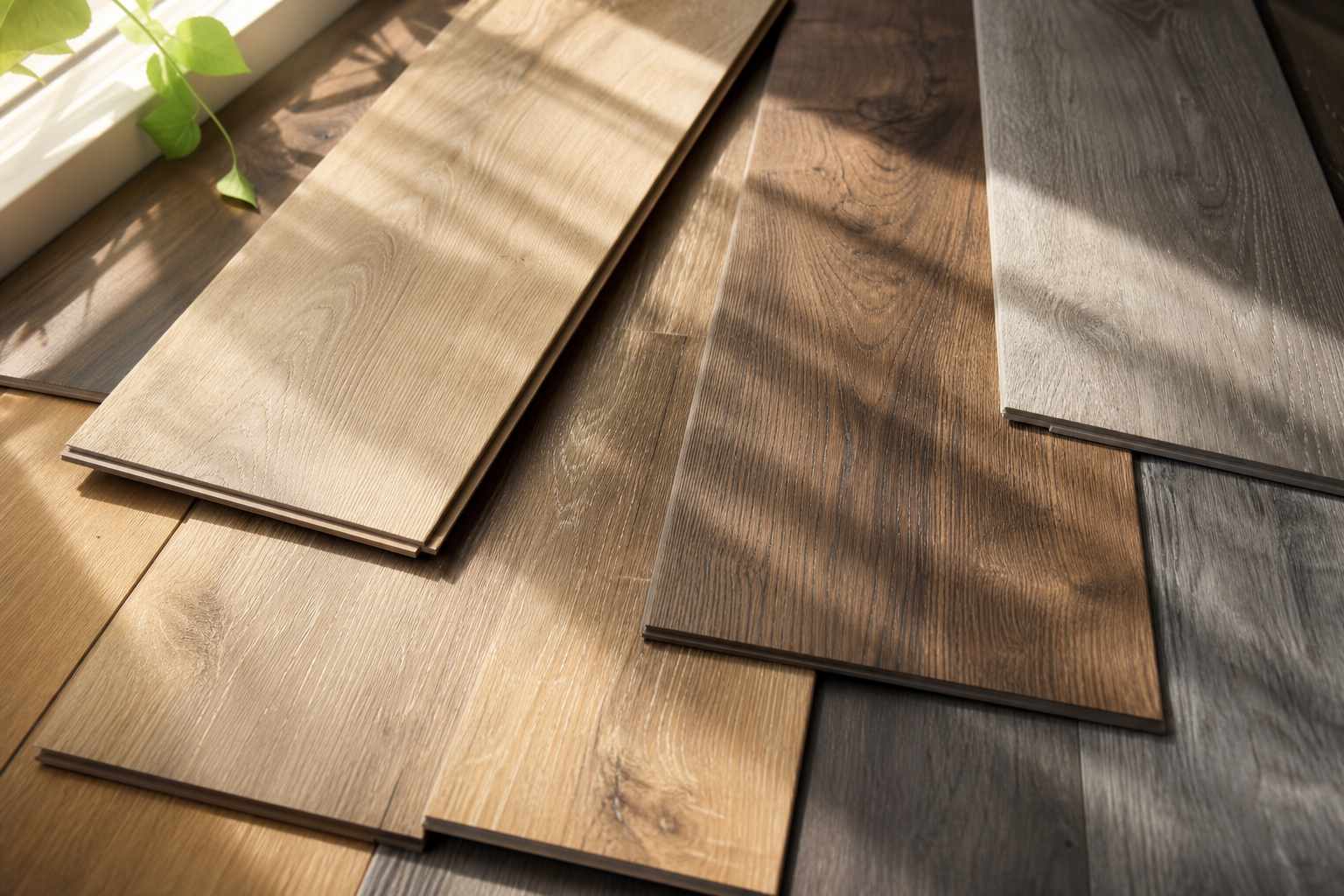
On summer Saturdays in our Colorado Springs showroom, I watch families walk past two LVP displays with almost the same color and almost the same price, then stop short at one and say, “That one looks more real.” They’re seeing something important. A more convincing wood look usually comes from design details you can judge with your own eyes, not just a higher ticket. If you are comparing collections before school starts and trying to make a smart choice once, this is what to look at.
What makes luxury vinyl plank look more like real wood? The short answer is texture, pattern control, plank-to-plank variation, edge treatment, and installation layout. A realistic luxury vinyl plank does not rely on one feature alone. It looks convincing when the printed grain, surface embossing, board size, and repeat pattern all work together across a larger installed area.
What makes luxury vinyl plank look more like real wood?
The biggest visual difference is not simply price. It is how well several design details line up, especially embossing that follows the grain, enough plank variation to avoid duplicates, believable edges, and an installation pattern that does not create obvious repeats.
Buyers often expect the answer to be wear layer, brand name, or “premium” labeling. Those matter for performance and sometimes for design options, but realism is mostly visual engineering. The best-looking floors tend to get five things right:
- Embossing in register. The texture lines up with the printed grain instead of floating randomly over it.
- Low repeat visibility. You do not notice the same knot, streak, or mineral mark every few boards.
- Natural color movement. The collection includes lighter and darker boards, not one flat tone repeated 20 times.
- Believable board shape. Width and length feel consistent with the wood style being imitated.
- Edge treatment that fits the look. Micro-bevels, square edges, or painted bevels can help or hurt depending on the design.
I tell customers this all the time. A floor can cost more and still look less convincing if the pattern repeats are obvious. Price can reflect warranty, construction, attached pad, or brand position. It does not automatically guarantee a more realistic luxury vinyl plank.
How does embossing change the look?
Embossing makes the surface catch light like wood instead of like printed plastic. The strongest version is embossing in register, where the texture follows the grain image closely enough that your eye reads it as one surface.
A weak example is a plank with a handsome oak print but a generic overall texture that runs across knots, cathedrals, and straight grain the same way. A stronger example is a plank where the grain ridges sit where the print says they should. Under morning or late-afternoon Colorado light, that difference is easy to spot.
Common mistake: judging from one board under one light
A single sample can make almost any floor look good. Trouble shows up after installation, when repeated visuals, flat texture, or shiny edges show up across 200 or 500 square feet. View the product under bright showroom light, indirect light, and if possible by a window. In Colorado Springs, our dry bright light exposes artificial-looking sheen fast.
Why do repeat patterns make some floors look fake?
Repeat patterns stand out because real wood has natural randomness, while printed flooring uses a limited number of image faces. The fewer unique plank visuals in a collection, the easier it is to spot duplicates.
This is one of the most important shopping criteria. Many buyers never ask how many unique plank patterns are in the box. They should. A collection with 6 or 8 faces can still look decent in a small area, but in open spaces the repeats may become obvious. A collection with 12, 16, or more faces usually gives the installer more freedom to spread out similar boards. According to the Floor Covering Installation Contractors Association, layout planning and product familiarity are major parts of a successful finished appearance, not just the physical act of putting planks on the floor.
That lines up with what we see every week. If the same dramatic knot appears every seventh board, your eye will find it. Once you see it, you cannot unsee it.
Colorado Springs homes often have large connected living areas and strong natural light, especially in newer neighborhoods around Falcon, Monument, and north side developments. Those wide, bright spaces make repeat patterns easier to notice than they might be in a smaller, darker room.
How do plank variation and color movement affect a realistic luxury vinyl plank?
More convincing collections usually show controlled variation from board to board. That means some contrast, some tonal movement, and some change in grain character, but not chaotic jumps that feel printed or forced.
Many shoppers accidentally choose floors that are too uniform because the display board looks calm and easy. After installation, that uniformity can read as flat. Real wood, even in cleaner grades, has movement. The goal is balance.
- Too little variation can look repetitive and manufactured.
- Too much high-contrast variation can feel busy and obviously designed.
- The best visual quality often sits in the middle, with enough change to look natural but not enough to dominate the room.
The National Wood Flooring Association is a useful reference point here because it shows how real wood naturally varies in grain, color, and character from board to board. LVP does not need to copy every mark to look believable, but the closer it captures natural variation patterns, the more convincing it looks.
If you are comparing two displays, stand back 8 to 10 feet. Then get close. A good floor should read well from both distances.
Do wider or longer planks always look better?
No. Board size looks more realistic when it matches the visual style of the floor. Very wide or very long planks can look great, but only if the grain scale, pattern spacing, and edge detail support that size.
Sometimes a 9-inch by 72-inch plank looks impressive on a display but exaggerated once installed if the printed grain is too small or too repetitive. A 7-inch plank with better pattern control may look more natural. This is exactly why visual quality has to be judged as a system, not a spec sheet.
| Design Detail | Weaker Visual Result | Stronger Visual Result |
|---|---|---|
| Embossing | Generic texture unrelated to grain | Texture aligned with grain image |
| Pattern count | Frequent duplicate boards | Duplicates spread out and harder to spot |
| Color variation | Flat, same-tone appearance | Natural board-to-board movement |
| Edge treatment | Dark or shiny grooves that outline every plank | Subtle edges that define boards without looking stamped |
| Layout | Obvious stair-step or H pattern | Randomized stagger that breaks up repeats |
How does edge treatment change whether LVP looks believable?
Edges matter because they define each board. A convincing edge should separate planks in a subtle, natural way. If the bevel is too deep, too dark, or too glossy, every plank gets outlined and the floor can start to look manufactured.
There is no one “best” edge for every buyer. What matters is fit.
- Square edge can create a cleaner, quieter look.
- Micro-bevel can add dimension and help individual boards read more naturally.
- Heavy bevel can work in some rustic visuals, but it can also call too much attention to the plank format.
A lot of families here are balancing appearance with everyday durability, especially with pets and kids. If that sounds familiar, our article on where luxury vinyl plank makes the most sense in a busy home explains the practical side, but visual quality is still worth slowing down for.
Myth: The most expensive LVP will automatically be the most realistic.
Reality: Price can reflect construction, waterproof system, attached pad, warranty length, brand, and thickness. Realism depends on design details you can inspect. I have seen mid-priced collections look more convincing than higher-priced ones because they had better embossing, more face variation, and less obvious repeats.
Why does viewing a larger sample area matter so much?
Larger sample areas matter because realism is judged across repetition, not on a single pretty board. You need enough surface area to see duplicates, color balance, edge lines, and how the texture plays with light.
This is probably the simplest way to shop smarter. If a store only shows a small hand sample, ask what the display rack, sample board, or loose carton boards look like together. Twelve boards are better than one. Twenty are better than twelve. If you can see several boxes opened or a large display panel, even better.
The World Floor Covering Association has long emphasized that consumers should inspect flooring carefully for color, pattern, and visible variation before installation. That sounds basic, but it is where many disappointments start. People approve a small sample, then dislike the full floor after the repeats show up.
At our store, I would rather spend 15 extra minutes helping you compare larger layouts than have you spend years looking at a pattern that bothers you. That is old-school advice, but it saves money.
Shopping checklist for more realistic luxury vinyl plank
- Ask how many unique plank visuals are in the collection.
- Check whether the embossing follows the printed grain.
- View at least 12 to 20 boards together, not one sample chip.
- Stand back 8 to 10 feet, then inspect from 2 feet away.
- Look at the floor under direct and indirect light.
- Study the bevel. Make sure it does not create dark grid lines.
- Ask how the installer will stagger boards to reduce visible repeats.
- Compare 2 or 3 collections side by side before deciding.
Can installation layout make the same product look better or worse?
Yes. Installation layout can improve or ruin the appearance of the exact same LVP. Even a good-looking product will look less natural if similar boards are grouped together or if the stagger creates a visible pattern.
Layout is where showroom choice meets craftsmanship. A careful installer pays attention to duplicate faces, end-joint spacing, and balance across the whole room. A rushed install can create stair-step lines or “H” joints that draw attention to the plank pattern. In open-concept homes, that becomes obvious fast.
- Open multiple cartons and mix boards before laying out rows.
- Watch for duplicate prints and separate them.
- Vary end-joint spacing to avoid mechanical-looking patterns.
- Check sight lines from the main entry and major seating areas.
- Use transitions and starting lines that support the visual flow.
If you want to understand how project planning affects the finished result, our article on what happens during a professional flooring measure shows the kind of details that get handled before ordering and installation.
John Hughes's Insights
I have been in flooring for more than 40 years, and I still think the smartest buyers are the ones who slow down long enough to compare the floor, not the sales tag. In my family, if you are going to spend real money on something, you learn how to judge it. Flooring is no different. I would rather show a customer why one realistic luxury vinyl plank looks better than another than push them toward the highest price in the store.
Here in Colorado Springs, a lot of folks are trying to get projects wrapped up before fall routines start again. That is exactly when it helps to visit a showroom with a plan. Bring photos, bring measurements if you have them, and ask to see larger sample areas. If a floor only looks good in a 9-inch sample, that is not enough for me.
How should buyers set priorities if they want the best visual value?
The best visual value comes from spending on the features you actually see. For most buyers, that means pattern variation, embossing quality, believable edges, and a careful layout plan before extras that do little for appearance.
Here is a simple way to prioritize:
- First, judge the overall visual. Does it look convincing across a larger area?
- Second, confirm the texture. Does the embossing support the grain?
- Third, ask about repeats. How many faces are in the collection?
- Fourth, inspect the edge. Does it define boards naturally or outline them too strongly?
- Fifth, talk through installation. Who is laying it out, and how will they avoid pattern issues?
If budget is tight, it can also help to compare other categories honestly. Our piece on upgrading floors on a budget with modern laminate gives a fair look at another path for value-minded buyers. The point is to judge what you are seeing clearly, not chase labels.
For households balancing style with heavy daily use, our article on best flooring for multiple dogs can help frame the durability side while you compare visuals.
"A realistic floor is usually a series of small right decisions, not one expensive decision." John Hughes
Need help judging which LVP actually looks best?
If comparing collections, sample boards, and layout options feels like one more project on your list, we can take that task off your plate. Visit O'Briens Carpet One Floor & Home or book a free in-home flooring measure and consultation, and we will help you sort out which realistic luxury vinyl plank gives you the strongest visual value for your home in Colorado Springs.
Schedule your free measure and consultation