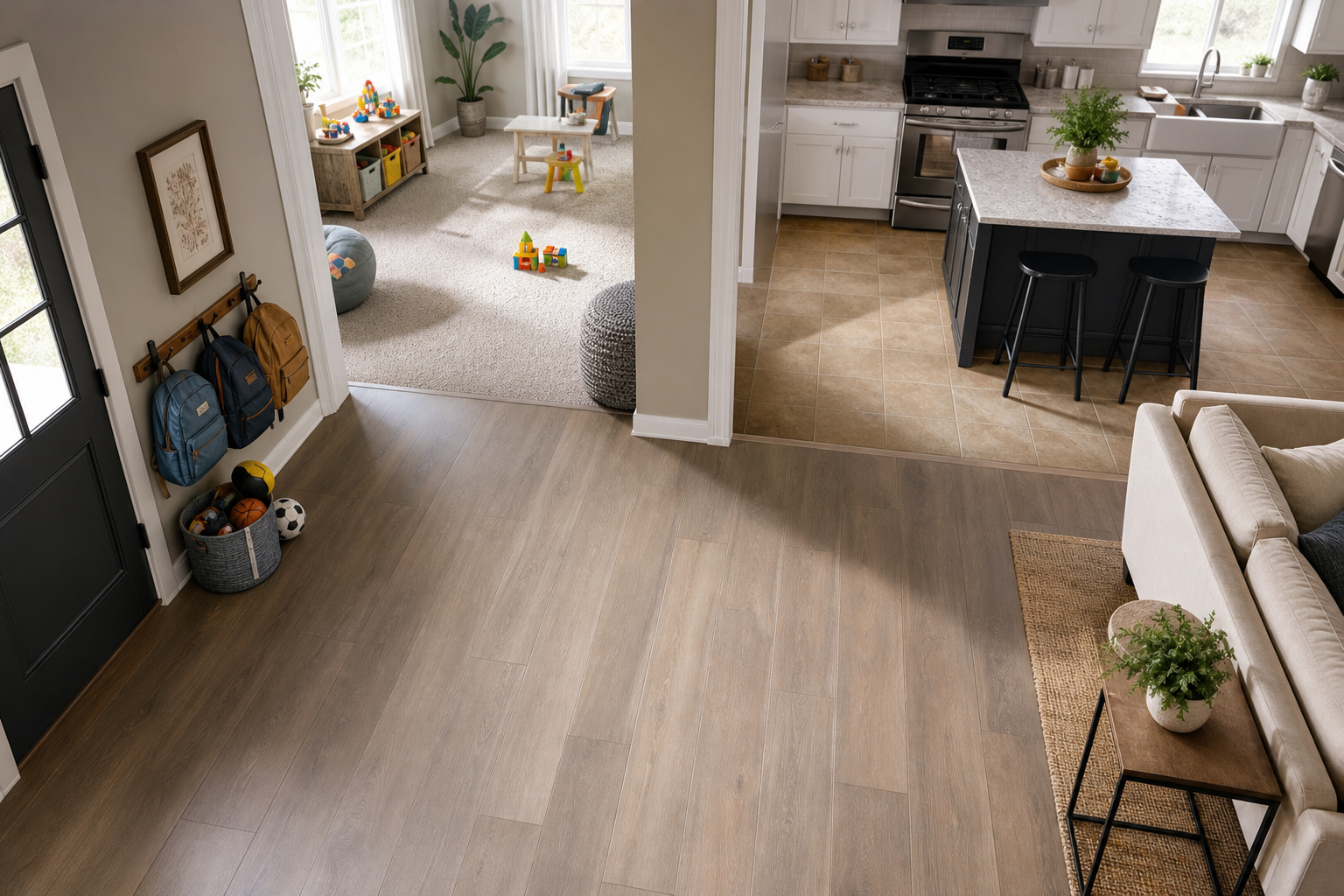
School backpacks are piling up by the door, cleats are grinding in a little Colorado dust, and somebody is already racing from the kitchen to the playroom before breakfast. That is usually the moment families in Colorado Springs start asking me where to use luxury vinyl plank in a home, and the honest answer is this. Luxury vinyl plank works very well in some busy rooms, but it should be part of a room by room plan, not a one floor fits all decision.
Which rooms are the best fit for luxury vinyl plank? In most active homes, LVP is a strong choice for entryways, kitchens, hallways, mudroom areas, and many playrooms because it handles daily traffic and cleans up easily. It is usually less ideal on stairs or in quieter spaces where sound, softness, and a warmer feel underfoot matter more.
Which rooms are the best fit for luxury vinyl plank?
The best fit for LVP is the part of the home that sees repeated traffic, tracked in grit, spills, and constant cleanup. In my experience here in Colorado Springs, that usually means entryways, main paths through the home, kitchen-adjacent spaces, and some family play areas. Those rooms benefit from LVP's easy maintenance more than they are bothered by its harder feel and sharper sound.
If you are deciding where to use luxury vinyl plank in a home, start by mapping how your family actually moves through the house on a weekday.
- Where do shoes land first?
- Where do kids drop lunchboxes and sports bags?
- Which rooms get wet, dusty, sticky, or scuffed every day?
- Which rooms are for relaxing, reading, or watching a movie with less chaos?
That is the difference between choosing a floor by sample board and choosing one by real life. I have been doing this for more than 40 years, and busy homes almost always need more than one flooring type to work well long term.
Is LVP a good choice for entryways and other high traffic rooms?
Yes, entryways and high traffic paths are often where LVP makes the most sense. These are the rooms where easy cleaning, water resistance, and scratch resistance usually outweigh concerns about sound and softness. If you are asking where to use luxury vinyl plank in a home, the front entry is one of the first places I would evaluate.
Entryways in Colorado Springs take a beating. We see snow, slush, de-icing residue, summer dust, and small gravel. A floor in that space needs to be realistic about mess. LVP gives families a practical surface that can be swept and wiped quickly, especially during the school year when everyone is in and out.
It can also work well in:
- Main hallways
- Mudroom-style drop zones
- Laundry rooms
- Kitchens and breakfast areas
- Open living spaces that connect directly to exterior doors
The tradeoff is feel and sound. LVP is not soft. If you stand on it a long time, it will feel firmer underfoot than some homeowners expect from the sample alone.
Does luxury vinyl plank make sense in a playroom?
Often yes, but only if you go in with realistic expectations. LVP can be a practical playroom floor because it is easy to clean after crafts, snacks, and pet traffic. It is not a no-damage floor, though, and it is not the softest surface for rough play, tumbles, or long sitting sessions.
Playrooms are one of the most misunderstood parts of where to use luxury vinyl plank in a home. Parents often like the idea of quick cleanup, and that part is true. Marker caps, crumbs, spilled juice, and puzzle pieces are easier to manage on LVP than on many softer surfaces.
But here is the other side.
- Dropped toys can dent or mark some LVP products.
- Plastic ride-on toys can create repeated wear in the same path.
- The room can sound louder because hard surfaces reflect more noise.
- Kids sitting on the floor may want area rugs, foam mats, or floor cushions.
The Federal Trade Commission advises buyers to review wear layers, product claims, and warranty terms carefully rather than assuming all vinyl flooring performs the same. Source: Federal Trade Commission.
My plain answer. A playroom with art projects and daily mess can be a good LVP room. A playroom that doubles as a crash zone for wrestling, movie nights, and floor lounging may need more softness worked into the plan.
Common mistake: treating a playroom like a miniature gym
Weak plan: install one hard floor wall to wall and assume it solves kid chaos. Stronger plan: use LVP for cleanup and durability, then add a large rug, play mat, or soft seating zone where children spend the most time on the floor. That gives you easier maintenance without pretending comfort does not matter.
Are stairs a smart place for luxury vinyl plank?
Sometimes, but stairs are one of the first places where I tell homeowners to slow down. LVP on stairs can look clean and coordinate well with nearby rooms, but sound, traction, edge detail, and long-term appearance all matter more here than many people expect.
Stairs get concentrated impact in a narrow space. Every step lands in a similar spot. That repeated use can show wear differently than an open room. Installation detail matters too. Stair noses, edges, and transitions have to be done right or the whole staircase can look pieced together.
Here is what I want families to think about before choosing LVP on stairs:
- Noise. Hard-surface stairs tend to sound louder, especially with kids running up and down.
- Comfort. Stairs are not a place where softness is irrelevant. A little cushion can change how the house feels.
- Safety and traction. The right product and install method matter.
- Visual transitions. Stair noses and floor height changes need a plan.
I am old-school about stairs. If the details are not right, you will notice them every single day.
In many Colorado Springs split-level homes and two-story family homes, the stairway sits right off the main entry or living space. That makes noise carry farther than homeowners expect, especially in open layouts common from Briargate to Security-Widefield. A good floor plan on paper can feel very different once footsteps echo through the house.
What about quieter living spaces, bedrooms, and rooms meant for relaxing?
LVP can work in quieter spaces, but it is not automatically the best answer. In rooms where comfort, warmth, and sound control matter most, another flooring type may fit the way the room is used better. This is where whole-home planning matters most.
Think about a reading room, formal sitting area, den, or bedroom retreat. These spaces usually do not get the same mess load as the entry or playroom. What people notice instead is how the room sounds and feels.
In quieter rooms, homeowners often care about:
- A softer first step in the morning
- Less echo and footfall noise
- A warmer, calmer feel
- A flooring look that suits a lower traffic setting
That does not mean LVP is wrong there. It means you should not assume the best floor for the busiest room is also the best floor for the quietest room. A whole-home flooring plan should let each room do its job.
Myth: If LVP is durable, it should go everywhere in the house.
Reality: Durability is only one part of the decision. Sound, comfort, transitions, and the way a room is actually used can matter just as much, especially in bedrooms, upper floors, and calmer living spaces.
How much maintenance, noise, and long term wear should you expect from LVP?
Expect easy routine cleaning, moderate underfoot noise, and some wear that shows up over time in real family life. LVP is practical, but it is not immune to dents, hard impacts, or the sound that comes with a hard surface floor.
This is the part I wish more salespeople would explain clearly. Families are often shown the upside and not enough of the tradeoffs.
- Maintenance: Daily sweeping and occasional damp cleaning are straightforward.
- Dents: Heavy furniture, dropped toys, and sharp concentrated impacts can leave marks.
- Noise: Footsteps, dog nails, and rolling toys can be more noticeable than expected.
- Long-term wear: Repeated traffic lanes and poorly protected furniture can change the look over time.
The Centers for Disease Control and Prevention has reported that U.S. children ages 6 to 17 spend an average of more than 7 hours per day on screen time and related entertainment behaviors, depending on the survey period and measure. Source: Centers for Disease Control and Prevention. That matters for flooring because families often underestimate how much time kids actually spend on the floor in bedrooms, bonus rooms, and shared living areas.
John Hughes says it this way: "A floor can be durable and still not be the most comfortable thing to live on all day. Those are two different questions, and families should ask both."
John Hughes's Insights
I have raised a big family here in Colorado Springs, and I can tell you active homes do not stay active in just one room. Kids cut corners, dogs skid through the hall, guests ignore the rug by the front door, and everybody ends up gathering where you did not plan for it. That is why I do not like blanket advice. If somebody tells you one floor is the answer for every room, they are selling a shortcut. I would rather walk the house with you, look at where the traffic really goes, and tell you where LVP earns its keep and where another floor may make daily life feel better. The right answer is usually a mix, and there is nothing wrong with that.
How do you mix LVP with other flooring types without making the house feel chopped up?
You mix flooring successfully by planning transitions early, keeping heights in mind, and letting room function lead the design. The goal is not to force one floor everywhere. The goal is to make each room work while keeping the home visually connected.
If you are working out where to use luxury vinyl plank in a home, transitions matter almost as much as the flooring itself. A clean whole-home plan should account for:
- Floor height differences between rooms
- Transition strip placement
- Doorway sightlines
- Color and texture coordination
- Stair edge details
A practical approach for busy families often looks like this:
- Use LVP in entry-connected spaces and daily traffic paths.
- Choose a quieter or softer flooring option where rest and comfort matter more.
- Coordinate tones so the house feels intentional, not patched together.
- Review every doorway and stair connection before installation day.
Most flooring problems I see are not product problems first. They are planning problems first.
"The best flooring plan is not the one that looks easiest in the showroom. It is the one that still makes sense after a wet winter entry, a noisy playroom, and five years of family traffic."
Frequently Asked Questions
Which rooms are the best fit for luxury vinyl plank?
Entryways, hallways, kitchens, mudroom areas, and many playrooms are usually the best fit because they benefit from easy cleanup and good traffic durability.
Is luxury vinyl plank too noisy for family homes?
It can be louder than some homeowners expect, especially on upper floors, stairs, and in open layouts. Underlayment, subfloor conditions, rugs, and room use all affect how noticeable that sound is.
Can LVP dent from furniture or toys?
Yes. It is durable, but not dent-proof. Heavy furniture, sharp objects, and repeated impact from hard toys can leave marks over time.
Should every room in the house have the same flooring?
Not usually. A better plan is to choose flooring by how each room functions, then coordinate colors and transitions so the home still feels connected.
Is LVP a good back-to-school flooring choice for families?
It can be, especially in drop zones, hallways, and rooms where kids track in dust, grass, and snack mess. Back-to-school season is a good time to rethink traffic flow before fall and winter weather arrive in El Paso County.
Plan your flooring room by room
If you are sorting out where to use luxury vinyl plank in a home, the best next move is to plan the busy rooms, quiet rooms, stairs, and transitions together. At O'Briens Carpet One Floor & Home, we help Colorado Springs homeowners build a whole-home flooring plan that fits real family life, not a sales script.
Book your free in-home flooring measure and consultationExplore more, or reach out directly to O'Briens Carpet One Floor & Home in Colorado Springs, CO.