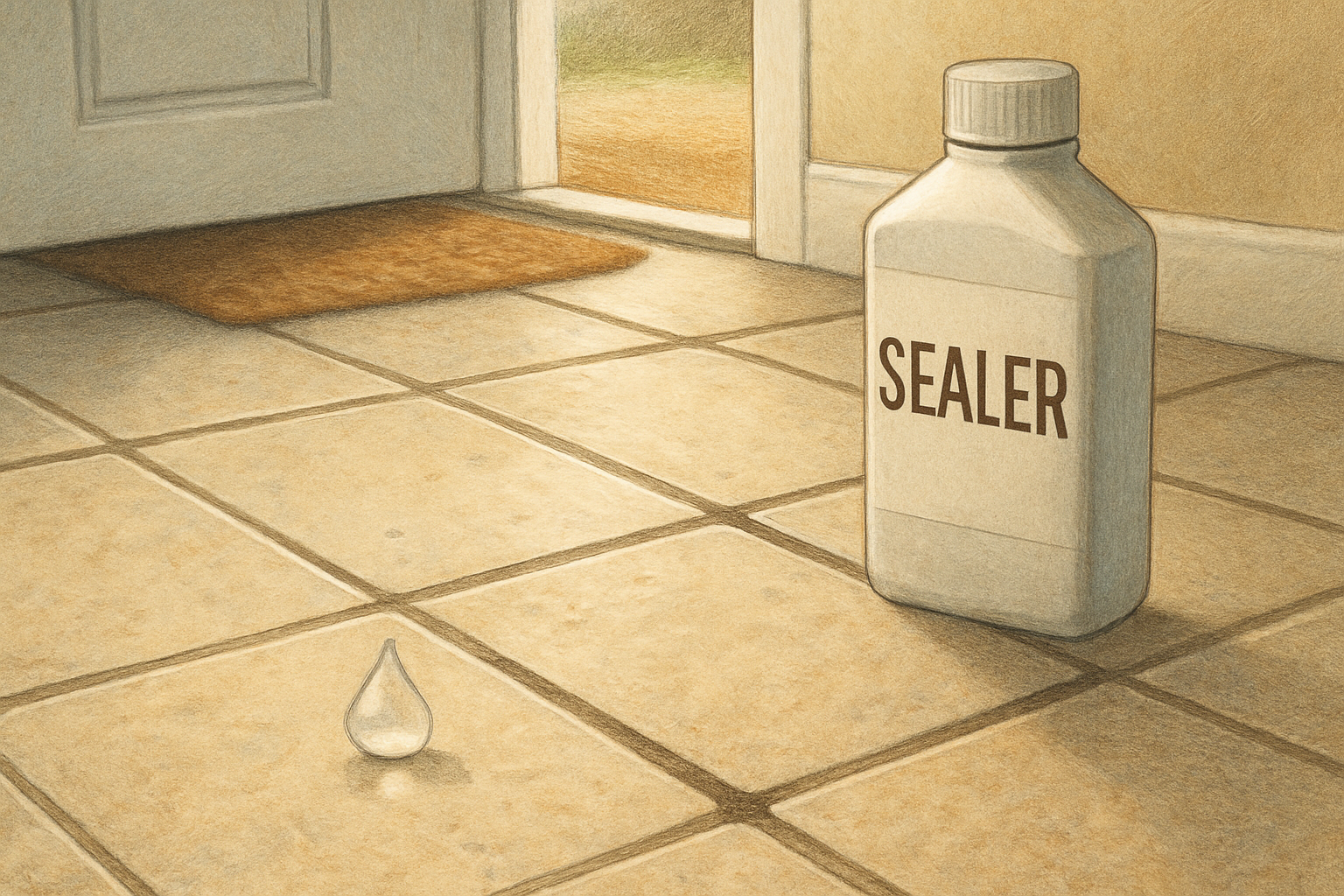
Homeowners in Colorado Springs buy a lot of tile-care products they do not actually need. The usual pattern is simple. A floor looks dull, grout looks blotchy, somebody sees white residue near the shower or entry, and the next step is a bottle of sealer. That is not always the right fix. If you are asking does tile need to be sealed Colorado Springs, the honest answer is that some parts of the installation may need sealing, some may not, and the manufacturer instructions should make the final call.
Do tile floors and grout need to be sealed? Sometimes, but not always. Many glazed tile surfaces do not need sealer at all, while some unglazed tile, many natural stones, and cementitious grout often may benefit from the right sealer. Epoxy and other alternative grouts often do not need sealing. In Colorado Springs, hard-water residue is also commonly mistaken for a sealer problem, so identify the surface and the buildup before buying a product.
Do tile floors and grout need to be sealed?
No, not every tile floor and not every grout joint needs sealer. The right answer depends on exactly what surface you are treating, who made it, and what that manufacturer says about care and warranty. That distinction matters more than the word “tile” on the package.
I have been in flooring long enough to see the same mistake over and over. Folks hear “tile should be sealed” and assume that applies to every shiny floor in the house. It does not. A tile installation can include at least 2 different maintenance categories right under your feet. The tile surface itself, and the grout between the tiles.
Here is the clean way to think about it:
- Glazed tile surfaces are often already protected by the glaze and typically are not sealed.
- Some unglazed tile products can be more absorbent and may call for a penetrating sealer.
- Natural stone often has very different care requirements from manufactured tile.
- Cementitious grout is commonly the part of the installation that may need sealing.
- Epoxy, urethane, and other specialty grouts often have different rules and may not need sealer.
The Tile Council of North America, at Tile Council of North America, publishes industry guidance that separates tile and grout performance by material type, not by a one-size-fits-all maintenance rule. That is the mindset I want homeowners to use before they spend money on products that can do nothing, or worse, create a residue problem.
Which parts of a tile installation may actually need sealer?
The tile surface and the grout joints should be evaluated separately. In many homes, the grout is the absorbent material while the tile face is not. In other homes, especially with some stones and unglazed products, both surfaces may need specific protection.
Do glazed tile surfaces need sealer?
Usually no. A glazed ceramic or glazed porcelain tile has a factory-applied surface layer that is already the wear and stain-resistant finish. Adding sealer on top often does not improve performance.
In plain English, if water beads on the tile face and the surface is dense and smooth, sealer may have nowhere useful to go. Some topical products can even leave haze, streaks, or a plastic-looking film that homeowners then mistake for tile wear. That is one reason the answer to does tile need to be sealed Colorado Springs is often “your grout maybe, your glazed tile probably not.”
Do some unglazed tile products need sealer?
Sometimes yes. Certain unglazed ceramic, porcelain, quarry tile, terracotta, encaustic-look products, or other absorbent finishes may call for sealing, especially if the maker says they are prone to staining.
This is where the carton instructions matter. Two tiles that look similar on a showroom wall can have different maintenance rules. One may be dense enough to need no treatment. Another may recommend a penetrating sealer before use in kitchens, mudrooms, or other spill-prone areas.
Does natural stone need sealer?
Often yes, but not universally and not with the same product for every stone. Marble, limestone, travertine, slate, and some granites vary widely in porosity, finish, and chemical sensitivity.
Natural Stone Institute guidance, at Natural Stone Institute, makes the same point I make in the showroom. Stone care is product-specific. A polished marble bath floor and a textured slate entry do not get the same cleaner or the same sealer just because both are “stone.”
Does cementitious grout need sealer?
Often yes. Traditional cement-based grout is porous, can absorb water and staining agents, and is commonly the part of the installation that benefits from a compatible penetrating sealer.
This is the part many homeowners are really asking about. They say “the tile needs sealed,” but what they are seeing is darkened grout, kitchen splashes, or shower residue collecting in the joints. In many installations, the grout is the maintenance focus, not the glazed tile.
Do epoxy or alternative grouts need sealer?
Usually no, but verify with the grout manufacturer. Epoxy grout and many high-performance single-component or urethane-based grouts are formulated for stain resistance and typically are not sealed like cement grout.
If you put the wrong sealer over an alternative grout, best case it does nothing. Worst case, it leaves a film or creates a cleanup problem. I tell customers this all the time. The bottle at the home center does not know what brand of grout is in your floor.
Common mistake: sealing first, identifying later
A weak approach is buying a “tile and grout sealer” and coating the whole floor because the grout looks dingy. A stronger approach is identifying 3 things first: the tile type, the grout formulation, and whether the problem is staining, residue, or wear. Those are different problems with different fixes.
Why do Colorado Springs floors look unsealed when the real problem is hard-water residue?
Hard-water deposits are a common false alarm in Colorado Springs. White film, cloudy spots, chalky edges, and stubborn shower buildup can make homeowners think the sealer failed, when the issue is mineral residue left behind by local water.
Colorado Springs Utilities reports water hardness in the local supply, and hard water leaves mineral deposits that build up on tile, glass, fixtures, and grout over time. You can review local water information at Colorado Springs Utilities. Those minerals do not disappear because a new coat of sealer goes down.
This shows up in a few predictable places:
- Shower floors and lower wall courses.
- Kitchen backsplashes behind sinks.
- Entry tile where snowmelt and dried mineral residue collect.
- Bathroom grout lines near tubs, toilets, and vanities.
In El Paso County homes, especially in areas from Monument to Fountain, I often see people blame the tile when the real problem is buildup from water or winter tracking. That is a cleaner issue first, not automatically a sealer issue.
Colorado Springs homes deal with a mix of hard-water spotting, snowmelt at entryways, and dry air that makes residue stand out visually on darker grout and matte tile. A floor in Falcon or Security-Widefield may need a different cleaning routine than a similar-looking floor in a softer-water region.
Myth: If tile or grout looks cloudy or chalky, it needs another coat of sealer.
Reality: Cloudiness is often mineral residue, soap film, cleaner buildup, or a bad previous topical product. Another coat can trap the problem, make streaking worse, or create a patchy appearance.
Why does cleaner compatibility matter before you use sealer or recoat?
Using the wrong cleaner can damage the surface, weaken previous treatments, or leave residue that blocks a new sealer from working properly. Before another coat goes down, the floor needs to be clean with products approved for that exact tile, stone, or grout type.
That matters a lot with natural stone and specialty grout. The U.S. Environmental Protection Agency, at EPA, notes the importance of following label directions for household cleaning chemicals. In practical flooring terms, stronger is not better if the chemistry is wrong.
Watch for these compatibility issues:
- Acidic cleaners can etch some natural stones and damage polished surfaces.
- Oil soaps and waxy cleaners can leave a film that attracts dirt.
- Harsh scrub products can roughen grout or remove factory-applied finishes on some surfaces.
- Topical shine products can create layers that peel or haze.
- Some cleaners can interfere with sealer penetration if residue is left behind.
If you are mid-project and comparing products, think about maintenance the same way you would think about warranties on other floors. We tell shoppers that in articles like Before You Buy LVP for a Busy Home, Read the Warranty Like an Owner, not a Shopper. The product category matters, but the manufacturer instructions are what control performance and what can void protection.
| Surface | Often Sealed? | Main Caution |
|---|---|---|
| Glazed ceramic or porcelain tile face | Usually no | Topical products may haze or do nothing useful |
| Some unglazed tile | Sometimes | Check absorbency and maker instructions |
| Natural stone | Often | Cleaner and sealer must match the stone |
| Cementitious grout | Often | Porous joints can stain if left unprotected |
| Epoxy or specialty grout | Usually no | Adding sealer may be unnecessary or incompatible |
What signs mean a floor should be evaluated before another sealer coat?
If the floor is blotchy, sticky, cloudy, unevenly dark, or hard to get clean, stop before recoating. Those are signs that the problem may be buildup, incompatibility, trapped residue, or surface wear instead of simple sealer loss.
Here are the main warning signs I would want checked first:
- Patchy sheen. Some areas look dull, others shiny. That can point to residue or a previous topical treatment wearing unevenly.
- White or chalky deposits. Common with hard water, especially in baths and around entries during winter.
- Sticky or tacky feel. Often a sign of cleaner film or incompatible maintenance products.
- Grout darkens in some spots but not others. Could be absorbed moisture, staining, or a failed spot treatment.
- Stone shows etching or rings. That is surface damage, not something sealer fixes.
- A fresh coat did not change anything last time. That is a clue the diagnosis was wrong the first time.
I like simple tests better than guesswork. If you can identify the material, do a small water-drop observation on a clean, dry, inconspicuous area and compare tile face to grout joint. If the grout darkens quickly but the tile does not, that tells you something useful. If residue appears on top no matter what, that points more toward cleaning and buildup than absorption.
"Most of the time, the problem is not that a homeowner forgot to buy enough sealer. The problem is they were sold a bottle before anyone identified what surface actually needed help." , John Hughes
How should Colorado Springs homeowners decide what to buy, if anything?
Buy less first, and identify more first. If you are wondering does tile need to be sealed Colorado Springs, the safest path is to match the product to the exact tile, grout, or stone you have, instead of buying a general-purpose treatment for the whole room.
Use this checklist before purchasing anything:
Product-specific care checklist
- Find the tile brand, series, and finish, or get a close identification from your installer or retailer.
- Confirm the grout type. Cementitious, epoxy, and single-component products do not get treated the same way.
- Read the manufacturer care instructions before applying cleaner or sealer.
- Identify whether the problem is staining, mineral buildup, soap film, etching, or wear.
- Test any cleaner or sealer in a small hidden area first.
- Do not assume a “tile and grout” label means safe for natural stone.
- Keep photos of problem areas, especially if the appearance changed after a previous product.
This is the same practical thinking we use in every floor category. If a customer is comparing surfaces for a busy house, we talk honestly about real-life upkeep, not just shelf labels. That is true whether somebody is reading our piece on what happens during a professional flooring measure or trying to sort out layout details in accurate transition planning for open floor plans. The details decide whether the finished floor works well and stays looking right.
If your tile is new and you are still choosing materials, this is also a good reminder to ask care questions before installation day. A floor that looks low-maintenance in a sample board can still have very specific grout or stone-care requirements once it is in a real family home with kids, pets, snowmelt, and Colorado Springs water.
That is why I tell people not to buy maintenance products the same way they buy paper towels. The wrong $20 or $40 bottle can create a much bigger cleanup job than the original problem.
If you want local help sorting out whether a floor needs cleaning, sealing, or simply the right maintenance routine, you can start with O'Briens Carpet One Floor & Home at https://www.obrienscarpetone.com. We work with Colorado Springs homeowners who are comparing materials, dealing with real household wear, and trying to avoid expensive guesswork.
Still asking, does tile need to be sealed Colorado Springs?
If you are not sure whether the tile surface, the grout, or hard-water residue is the real issue, we can help you sort that out before you buy another product that may not belong on your floor. O'Briens Carpet One Floor & Home offers a free in-home flooring measure and consultation for Colorado Springs area homeowners who want straight answers and product-specific care guidance.
Book your free in-home flooring measure and consultation