July in Colorado Springs moves fast. One night you are shoulder to shoulder with families downtown, the next weekend you are out near a park, plaza, or neighborhood gathering where music, food, and conversation all compete for a few seconds of attention. The hard part is not getting seen. The hard part is being remembered without trying to outshout everyone else.
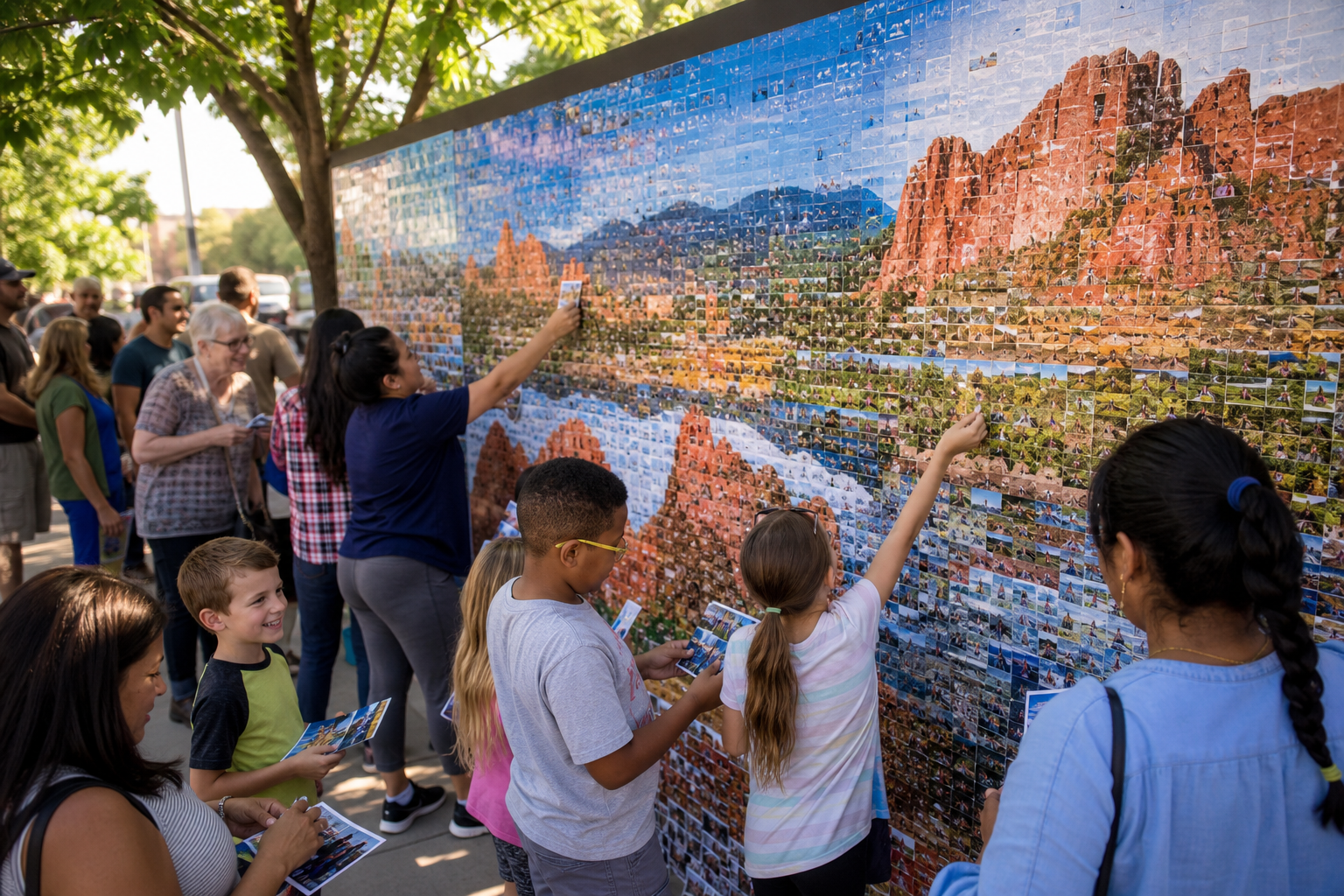
An interactive community activity that helps a business build meaningful local connections at summer events is a live photo mosaic built from attendee-submitted images during the event, then displayed afterward inside the business. It works because people do not just view it. They help make it, return to find themselves in it, and keep talking about the shared experience long after the tents come down.
If you are looking for interactive community event ideas Colorado Springs businesses can use without making the day feel like one more promotion, collaborative creation stands out. People remember the experience they helped create more than the display they merely walked past. That difference matters in a city where summer calendars fill up fast and attention gets sliced into tiny moments.
What is an interactive community activity that helps a business build meaningful local connections at summer events?
A live photo mosaic is one of the strongest answers because it turns a crowd into contributors. Attendees submit photos on site, watch the larger image take shape over hours, and later see the finished piece continue to live inside the business. That shared authorship creates a stronger memory than a static sign or backdrop ever could.
Picture a Colorado Springs summer event in motion. Kids are bouncing between activities. Parents are carrying cold drinks and checking where the next performance starts. Teenagers want something visual and fast. Older guests want something easy to join without a steep learning curve. A photo mosaic meets all of them in the middle.
Here is how it works in practice:
- Guests take or submit a photo during the event.
- Each image becomes a small tile in a much larger picture.
- The larger image updates throughout the event, giving people a reason to circle back.
- After the event, the finished installation moves into the business as a permanent or semi-permanent display.
That is why interactive community event ideas Colorado Springs audiences respond to often have one thing in common. They invite participation without demanding performance. People can contribute in a few seconds, but the emotional payoff lasts much longer.
In Colorado Springs, that matters even more in July. The light stays bright late, event schedules run back to back, and foot traffic can shift quickly between Old Colorado City, downtown, and community park gatherings. An activity that gives people a reason to return later in the same event is far more memorable than one they absorb in passing.
Why do people remember collaborative experiences more than displays they only pass by?
People remember collaborative experiences more because participation creates ownership. A static display asks for attention. A collaborative display asks for contribution, and the brain tends to hold onto moments where someone had a role in the outcome.
There is real proof behind that. According to Eventbrite, 78 percent of millennials said they would choose to spend money on a desirable experience or event over buying something desirable. That finding gets quoted often because it reflects a broader shift that still shows up at local events today. People talk about what they did, not just what they saw.
The science supports the memory side, too. The American Psychological Association has published wide-ranging work on memory formation showing that emotionally engaging and personally relevant experiences are more likely to stick. A mosaic built from your own photo is personally relevant in a way a printed banner will never be.
I have a simple rule here. If someone can walk by your setup and forget it by the time they reach the food line, you did not build a moment. You built scenery.
A live mosaic changes the rhythm of attention:
- It gives attendees a job, not just a viewing angle.
- It creates anticipation as the larger image slowly appears.
- It rewards repeat visits during the same event.
- It keeps the story going after the event ends.
How does a community photo mosaic work during a Colorado Springs summer event, then continue afterward?
A community photo mosaic works best as a live installation that evolves during the event and then moves indoors as a finished piece. The public sees it being built in real time, which creates momentum, and the business keeps it visible afterward, which turns one event into a longer local conversation.
Here is the stronger version of the idea compared with the weaker one.
Weak version versus strong version
Weak: Set up a finished display and hope people stop for a photo.
Strong: Invite attendees to help build the display itself, show progress live, and install the final piece inside your space so people can visit it again later.
During the event, the mosaic becomes a magnet because it is never quite finished. Every new contribution changes the image. A family that added a photo at 2 p.m. might come back at 4 p.m. to spot their tile. A volunteer might bring over a friend to show how much it has grown. That repeat engagement is the whole point.
Afterward, the piece gains a second life inside the business:
- Customers come in and look for their image.
- Neighbors bring visiting friends to show where they took part.
- The business now has a physical story tied to a real community moment.
- Future conversations start with shared memory, not a sales pitch.
According to U.S. Census Bureau QuickFacts, Colorado Springs has a population of more than 480,000 people. In a city that size, community connection grows through repeated touchpoints, not one-time visibility. A finished mosaic inside a local business gives those touchpoints a physical home.
Framed Event said it best: “The moments people keep are the ones they can point to and say, I was part of that.” That is exactly why this format sticks.
How should a business choose a collaborative activity based on audience size, available space, and accessibility?
The right collaborative activity should match crowd volume, fit the real footprint available, and be simple for different ages and mobility levels to join. A photo mosaic works well because it scales up or down without losing the basic experience.
Use these decision criteria before choosing your format:
Selection criteria for a collaborative activity
- Audience size: Large crowds need quick participation. A photo submission takes less time than a hands-on craft station and avoids long waiting lines.
- Available space: Tight footprints need vertical or screen-based presentation. Open areas can support a larger visible build wall that draws people from farther away.
- Dwell time: If attendees move constantly, use an activity that can be completed in under a minute. If they linger, add a viewing area so they can watch the image grow.
- Age range: The best community builds feel intuitive to children, teens, parents, and older adults without needing different instructions for each group.
- Mobility access: Make sure participation does not depend on stairs, long standing periods, or hard-to-reach interaction points.
- Visual clarity: People should understand what is happening from several feet away. Confusion kills momentum fast.
Most businesses make this harder than it needs to be. If the activity requires a staff explanation every single time, it is probably too complicated for a busy summer crowd.
Accessibility deserves its own attention. The activity should work for:
- Children who want a fast, visual way to join.
- Adults carrying bags, drinks, or strollers.
- Older guests who may prefer a simple process and seating nearby.
- People using wheelchairs or other mobility supports.
That means thinking through details such as screen height, turning space, readable instructions, shade, and submission methods that do not rely on one physical position. In Colorado Springs, afternoon sun can turn a fun station into a place people avoid. Comfort affects participation more than people admit.
Myth: Interactive means complicated, messy, or best suited only for kids.
Reality: The strongest collaborative activities are often the simplest. A live photo mosaic is visual, quick, and flexible enough for mixed-age crowds, limited space, and varying mobility needs.
How can the finished installation become an ongoing community conversation?
The finished installation becomes an ongoing conversation when it stays visible, easy to revisit, and clearly tied to the people who helped create it. The goal is not just to preserve the event. It is to keep the community seeing itself inside your space.
That is where this idea becomes more than one of many interactive community event ideas Colorado Springs businesses try for a weekend. It turns into a landmark memory wall. Someone walks in weeks later and says, “We were there.” Another person spots a familiar face. A parent shows their child how their photo became part of the full image.
To keep that conversation alive, the installation should:
- Be placed where visitors naturally pause.
- Show the full image clearly from a distance.
- Reward close viewing, so people look for individual tiles.
- Connect back to the local event or season that created it.
I like displays that keep people in the room a little longer than they planned. That extra minute is where conversation starts.
This kind of piece also changes how a business is remembered. Specific services may not be the first thing people discuss, and that is fine. The stronger brand presence comes from being the place that hosted, held, and honored a shared local moment. That is a deeper impression than a service list on a signboard.
Framed Event's Insights
I love ideas that feel alive while they are happening. A photo mosaic has that pulse. It starts small, then every new face, family, volunteer, and group shot adds another beat to the picture. At a summer event in Colorado Springs, where everything moves fast and there is always another sound pulling people away, that matters. You need something people can join instantly and remember later.
What I like most is that it does not ask anyone to become a performer. They can contribute in a comfortable, natural way. Then the payoff arrives twice. First at the event, when they come back to see the image grow. Then later, inside the business, when the moment has turned into something lasting. That is the kind of visual memory people talk about for months, because it belongs to them too.
Frequently Asked Questions
Is a photo mosaic only a fit for very large events?
No. It can scale for neighborhood gatherings, midsize summer events, or larger city crowds. The key is matching the display size and submission flow to expected turnout.
Why is this better than a static display?
Because participation builds emotional ownership. People are more likely to remember and revisit something they helped create.
Does this work for mixed-age audiences?
Yes. It is one of the more flexible interactive community event ideas Colorado Springs organizers can use because the action is simple, visual, and low-pressure for children, teens, adults, and older guests.
What if space is limited?
A mosaic can be adapted to a smaller footprint, especially if the visible build happens vertically or digitally. What matters most is that people can understand it quickly and see progress.
How does it help a business if services are not the focus?
It reinforces memory and goodwill through shared experience. People remember the business as part of a meaningful local moment, which can be more lasting than a direct promotional message.
"People remember the experience they helped create more than the display they merely walked past."
Give people something worth building together
If your next summer appearance needs more than visibility, a collaborative installation can solve the real problem. It gives people a meaningful role in the moment, then keeps that connection alive after the event ends. If you are exploring interactive community event ideas Colorado Springs businesses can use to create lasting local memory, K2Q Factory can help you think through what people will actually remember. Turn big moments into unforgettable visuals.
Visit k2qfactory.comExplore more, or reach out directly to K2Q Factory in Colorado Springs, CO.