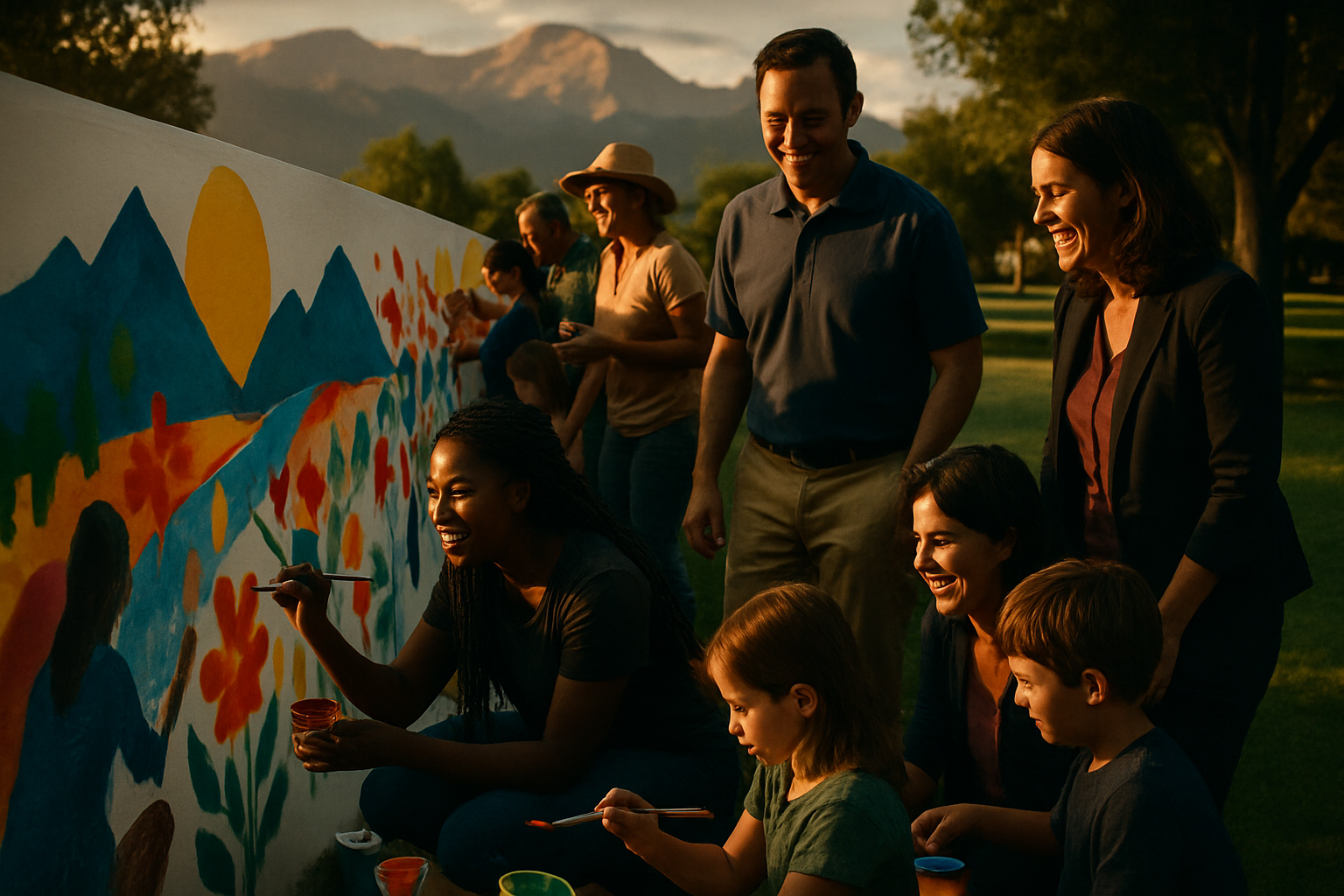
July in Colorado Springs can feel like one long moving crowd. Farmers markets fill up early. Neighborhood concerts spill into the evening light. Street fairs, park gatherings, downtown activations, and weekend festivals all compete for the same few seconds of attention as people stroll by with iced drinks, kids, strollers, and a dozen places to be next. In busy public spaces like these, the businesses people remember are rarely the ones talking the loudest. They are the ones giving people something to do together.
Interactive community experiences help a local business become more memorable at summer events when they invite simple, shared participation. The strongest examples are collaborative art pieces, story walls, mini challenges, and quick hands-on moments that spark conversation between strangers, families, and friends. People remember what they helped create, not just what they walked past.
What kinds of interactive community experiences help a local business become more memorable at summer events?
The best interactive community experiences for Colorado Springs businesses are simple group activities that create a shared moment in under two minutes. Think collaborative murals, “add your memory” story walls, neighborhood map pins, mini team challenges, or visual builds that grow as more people join in. These experiences work because they turn a brand from a backdrop into part of the event’s social energy.
That difference matters in a packed summer calendar. A passive display asks people to notice you. A participatory experience gives them a reason to stop, contribute, laugh, compare, and talk about it later. That is how local brand recognition gets stronger. Not through more signage, but through a moment people can feel themselves being part of.
Researchers at EventTrack have repeatedly found that people show stronger favorability toward brands after live experiences, especially when the experience feels meaningful and memorable rather than purely promotional. The exact activity can be small. The impact comes from the shared action.
- Collaborative art: Guests add one brushstroke, sticker, shape, or color to a growing mural.
- Local story walls: People finish prompts like “My favorite Colorado Springs summer memory is…”
- Mini challenges: Quick timed tasks, neighborhood trivia, or teamwork games built for spectators as much as participants.
- Community vote installations: Attendees place tokens, pins, or marks on a question that reflects local identity.
- Build-as-you-go displays: Every participant adds one piece to a larger visual that transforms over the day.
"The moments people talk about later are usually the ones where they got to step into the frame, not just walk past it."
Why are participatory experiences remembered more than passive displays?
Participatory experiences are remembered because they create ownership, emotion, and social connection at the same time. A display can be attractive, but an activity gives people a role. The second someone adds a note, makes a choice, or joins a challenge, the moment becomes theirs too.
That is not just a creative opinion. According to the American Psychological Association, active participation and emotional engagement support stronger memory formation than passive exposure alone. In event terms, that means people are more likely to remember the business that invited them into a moment than the one that simply placed a banner in the background.
Here is the contrast I see all the time:
- Passive display: A polished setup with signage, products, and a nice backdrop. People glance, maybe snap a photo, and keep moving.
- Participatory moment: A “Paint one piece of this Pikes Peak sunset” wall where every visitor adds a color block. People stop, point, compare sections, bring friends back, and watch the piece change all day.
The second one creates motion, conversation, and proof that something is happening here. Most businesses do not have an attention problem. They have a participation problem.
How should a business choose the right activity for its audience?
The right activity matches the speed, age mix, energy level, and setting of the crowd. A good interactive idea is not just clever. It fits how people actually move through the event, who they are with, and how much time they are willing to give.
For Colorado Springs businesses, audience fit usually comes down to five criteria.
Experience selection criteria
- Time to join: Can someone understand it in 5 seconds and participate in 30 to 90 seconds?
- Social shape: Is it built for one person, pairs, families, or small groups watching each other?
- Emotional tone: Should it feel playful, reflective, competitive, artistic, or community-driven?
- Physical accessibility: Can children, older adults, and people with limited mobility join comfortably?
- Visual payoff: Does the activity become more interesting as more people participate?
A family-heavy event near parks or school communities may respond best to simple collective art or game-style interaction. A downtown audience during evening events may lean more toward story prompts, visual voting, or striking photo-led collaboration. If you are near tourist traffic around Old Colorado City or visitors exploring after Garden of the Gods, the activity needs to read instantly and work without much explanation.
Weak example: “Enter to win” bowl on a table.
Stronger example: “Place one marker on the Colorado Springs spot that feels most like summer to you.” Now people look, point, compare, and tell stories.
Colorado Springs summer events often bring mixed crowds. Locals, military families, tourists, kids, grandparents, and friend groups all move through the same space. At higher elevation, bright sun and afternoon heat also shorten attention spans, which is why the best activities here are fast to join, easy to understand, and visually clear from a distance.
How can businesses keep participation accessible for all ages?
Accessible participation starts with low friction. The best interactive community experiences for Colorado Springs businesses do not require special knowledge, lots of reading, fine motor precision, or waiting in a long line. They invite people in quickly and make success easy.
Accessibility is not only about compliance. It is about making the experience feel open to the full community.
- Use one clear instruction, in large readable type.
- Offer standing and seated ways to join, if possible.
- Keep physical actions simple, such as placing, writing, choosing, drawing, or stacking.
- Make prompts broad enough for kids and adults to answer differently.
- Design for spectators too, so people can enjoy the moment before deciding to join.
- Reduce embarrassment. No one should feel they need to be artistic, athletic, or outgoing to participate.
I like experiences that let a shy 8-year-old and a chatty grandparent both find their place in the same moment. That is where community texture shows up.
For example, a local story wall can offer layered prompts:
- Kids: “Draw your favorite summer memory.”
- Teens and adults: “Write one Colorado Springs place that always feels like summer.”
- Everyone: add a sticker, color, or symbol to a growing community image.
According to the U.S. Census Bureau, Colorado Springs has a broad mix of household types and age groups, which makes all-ages design especially important for public event engagement.
The common mistake
Businesses often confuse “interactive” with “complicated.” If someone needs a long explanation, a download, a form, or a perfect skill set, participation drops fast. The simpler the action, the more likely it is to create a real crowd moment.
What do strong local implementation examples look like in Colorado Springs?
Strong local execution looks rooted in place, not imported from a generic event template. The most memorable interactive community experiences for Colorado Springs businesses reflect local scenery, neighborhood pride, summer routines, and the way people gather here.
Here are a few examples that fit the city well:
- Pikes Peak color build: A large mountain outline that fills in one section at a time as guests add tiles, brushstrokes, or colored tags.
- Summer memory wall: “Finish this sentence: A perfect Colorado Springs summer day includes…”
- Neighborhood pride map: Guests place markers on favorite picnic spots, trail views, concert locations, or ice cream stops.
- Mini team challenge: Simple pair or family challenges with a visible scoreboard that is playful, not high-pressure.
- Community photo sequence: People contribute one pose, movement, or sign to a growing visual series that becomes a single final piece.
The strongest version is usually not the flashiest. It is the one that creates a little circle of people around it. If passersby stop because they want to see what others are doing, you are on the right track.
Framed Event's Insights
I have seen this over and over at sports events, festivals, and public celebrations. The moment people remember is rarely the cleanest setup. It is the one with a pulse. It is the mural getting fuller every ten minutes. It is the parent helping a kid add their piece. It is two strangers reading the same story prompt and laughing because they wrote almost the same answer.
If I were judging an event activation in Colorado Springs, I would ask one thing first. Did it create a scene people wanted to step into? That is the whole game. Your brand should feel like it belongs inside the energy of the event, not like it arrived with a folding table and a script. Build the moment so people leave saying, “Did you see that?”
How can the same experience continue inside the business after the event?
The smartest event concepts do not end at the event. They continue inside the business as a visual reminder, a conversation starter, or an ongoing community piece that keeps the original feeling alive.
This is where thoughtful experience design really strengthens local brand recognition. If people encounter the same story, artwork, or shared prompt again after the event, the memory gets reinforced.
Ways to carry it inward:
- Display the completed collaborative artwork in-store or in the lobby.
- Turn story wall responses into a printed installation or rotating feature wall.
- Create a seasonal series, where each event adds another chapter to the same community project.
- Use event-created visuals in interior signage, windows, or branded decor.
- Invite future visitors to continue the piece in a smaller everyday version.
For a visual-first company like K2Q Factory, this is where things get exciting. A shared public moment can become a lasting visual asset, filmed, photographed, edited, and transformed into something people see again later. Good event design should not vanish with teardown. It should keep telling the story.
Myth: A business becomes memorable at summer events by being the loudest or most promotional.
Reality: People remember the business that helped them have a moment with other people. Shared participation beats pure visibility almost every time.
Frequently Asked Questions
What kinds of interactive community experiences help a local business become more memorable at summer events?
Collaborative art, story walls, visual voting stations, quick team challenges, and build-as-you-go displays are some of the most effective options because they invite shared action and conversation.
How long should an event activity take?
Usually 30 to 90 seconds for basic participation is ideal. People at summer events in Colorado Springs are moving, often with family or friends, so short entry points work best.
Do interactive experiences need a lot of technology?
No. Many of the strongest ideas are analog. Paint, markers, tokens, prompts, movable pieces, and simple visual structures often outperform tech-heavy setups because they are easier to join instantly.
What makes an activity feel local?
Local references, familiar landmarks, shared summer routines, neighborhood pride, and community storytelling all help. The experience should feel like it could only happen in Colorado Springs, not anywhere.
How does this help brand recognition?
People connect the good feeling of participation with the business that hosted it. If the activity is visually memorable and continues inside the business afterward, recognition gets even stronger.
Evaluate your next event through the lens of shared experience
If your challenge is standing out in a crowded Colorado Springs summer calendar, start by asking what people can make, answer, build, or experience together. The most effective interactive community experiences for Colorado Springs businesses do more than attract a glance. They create a scene people remember. If you want help shaping those moments into visuals that last after the crowd clears, K2Q Factory is built for exactly that. Turn big moments into unforgettable visuals
Visit k2qfactory.comExplore more, or reach out directly to K2Q Factory in Colorado Springs, CO.