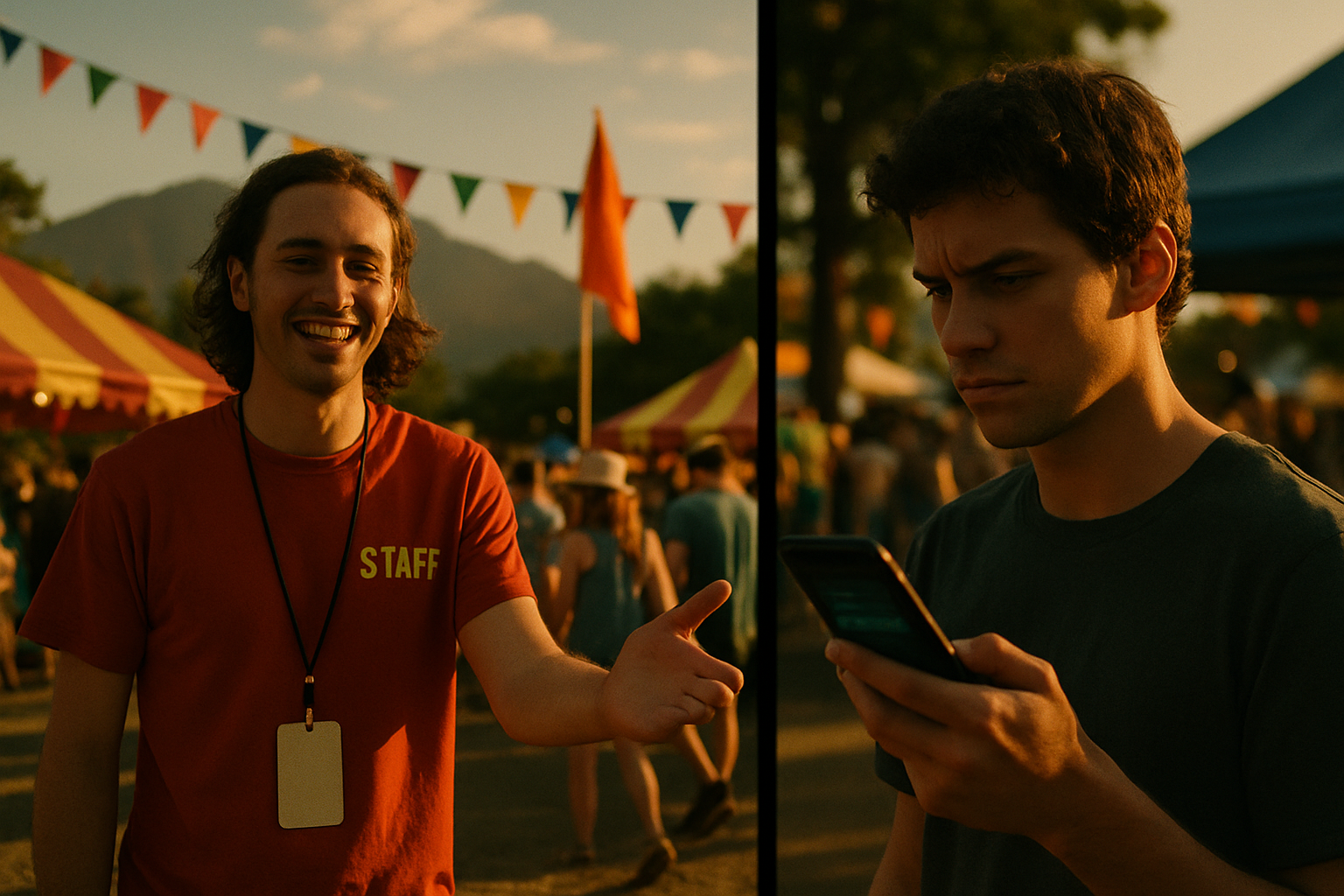
Walk through a summer festival in Colorado Springs and you will see it everywhere. Phones in back pockets at Territory Days, held up for photos downtown, pulled out in line for schedules, maps, weather, and last minute updates. That reality matters, but it does not mean every event experience should be pushed onto a screen. The smartest mobile engagement at community events respects the moment first, then uses technology where it actually helps people move, decide, and participate.
Businesses should use mobile engagement during community events when it reduces friction, improves timing, or gives attendees useful information they can act on right away. It works best for schedules, navigation, live updates, offers, and simple participation. It works poorly when the moment depends on trust, conversation, accessibility, or human warmth.
When should businesses use mobile engagement during community events?
Businesses should use mobile engagement at community events when the phone becomes a convenience instead of a barrier. If it saves time, prevents confusion, helps people find what they need, or supports the live atmosphere without interrupting it, it earns its place. If it distracts from the reason people came, human interaction usually wins.
That is the balanced answer, and it is the one more organizers need to hear. Mobile is not the hero of every event story. Sometimes the best move is a text alert or mobile map. Sometimes the best move is a volunteer at the gate making eye contact and answering a question in ten seconds.
Pew Research Center reported in 2024 that 91 percent of U.S. adults own a smartphone. That makes mobile behavior a real part of event planning, not a niche tactic. Still, ownership does not equal preference in every moment. A family juggling sunscreen, strollers, and snow cones at a weekend street fair is not always looking for one more digital step.
I think this is where event strategy gets off track. People do not attend a Colorado Springs event because they want more screen time. They attend because they want the feeling of being there.
Where does mobile engagement actually improve the attendee experience?
Mobile engagement at community events improves the experience when attendees need speed, clarity, or timing. Good uses are practical and immediate. They remove friction from a crowded day instead of adding one more task.
Here is where mobile tends to help most:
- Real-time schedule changes. Afternoon thunderstorms can roll across the Front Range fast. If a performance time shifts or a family zone moves indoors, mobile updates beat a printed sign every time.
- Maps and wayfinding. Large venues, multi-block festivals, and sports complexes benefit from simple mobile maps, especially for parking, entrances, restrooms, and first aid.
- Timed offers and event-specific prompts. A lunch special during a gap in programming, a reminder that a film starts in 15 minutes, or a prompt to vote in a people’s choice contest can feel useful if it is relevant and brief.
- Participation that does not require waiting. Simple polls, scavenger clues, photo contests, or RSVP confirmations can keep the experience moving.
- Post-event follow-through. Sharing highlight galleries, recap videos, or next-event information after the crowd heads home often makes more sense than trying to force interaction in the busiest moment.
A strong example looks like this:
- Weaker: Asking every attendee to complete multiple phone steps just to enter a booth.
- Stronger: Posting one short mobile-friendly link for the live schedule, weather updates, and venue map, then letting staff handle personal questions on the ground.
That difference matters. One supports the event. The other hijacks it.
Colorado Springs events have a local wrinkle that planners cannot ignore. Blue-sky mornings can turn into windy afternoons, and summer heat at open-air venues can make people impatient fast. Mobile updates are most helpful here when they solve weather and timing issues without forcing attendees to stop and stare at their phones in the middle of the action.
When does face-to-face engagement work better than mobile?
Face-to-face engagement works better when people need reassurance, context, enthusiasm, or a fast answer with no instructions. Human interaction is stronger for welcome moments, emotional moments, and any situation where technology would slow the energy down.
This is especially true in these situations:
- First impressions. A smiling greeter, a volunteer pointing the way, or a staff member helping a parent with kids sets the tone faster than a screen ever will.
- Complex questions. If someone is confused about where to sit, how to participate, or what is included, a conversation solves it better than a self-serve prompt.
- Sponsorship and brand trust. If a business wants to be remembered as helpful and local, having a real person engage naturally often beats any digital prompt.
- High-energy live moments. A halftime activation, live demo, youth sports celebration, or artist meet-and-greet should feel present and alive, not filtered through a phone.
- Accessibility and comfort. Not every attendee wants to scan, tap, download, or read small text under bright sun.
The Eventbrite organizer resources have long emphasized that attendee experience is shaped by flow, clarity, and emotional connection, not just event tech choices. That tracks with what I see at great local events. The most memorable moments usually happen eye to eye.
A common mistake
Replacing staff with mobile steps because it feels more efficient. At a packed community event, efficiency without warmth can feel cold, confusing, and harder to navigate than a simple conversation.
Framed Event says it best: “The phone should support the memory, not become the memory.” That is the line I keep coming back to.
What decision criteria should businesses use before adding mobile features?
Businesses should choose mobile tools based on attendee need, event pace, staff capacity, and the type of interaction they want people to remember. The right question is not “Can we make this mobile?” It is “Should this moment happen on a phone at all?”
Use these criteria before adding mobile engagement at community events:
- Does it save time?
If the mobile step cuts confusion or waiting, it may be worth it. If it adds one more instruction, skip it. - Is the information time-sensitive?
Schedule updates, line changes, and event reminders are strong fits. - Can someone still participate without a phone?
If the answer is no, you are building exclusion into the event. - Will people be physically able to use it in the moment?
Think sun glare, weak signal, wet hands, kids in tow, gloves, noise, and battery life. - Does the brand moment require conversation?
For trust-building, storytelling, and local goodwill, people usually outperform screens. - Is there staff support if the mobile tool fails?
A backup plan is not optional.
A practical event planning checklist
- Keep mobile interactions under 30 seconds whenever possible.
- Offer a non-mobile option for the same task.
- Test visibility in bright daylight.
- Assume at least some attendees will have low battery or poor reception.
- Train staff to guide, not just point at signage.
- Measure attendee ease, not just interaction counts.
Most bad event tech decisions are not caused by bad tools. They come from forgetting what the day actually feels like on the ground.
How should accessibility and customer expectations shape mobile choices?
Accessibility and customer expectations should shape every mobile decision because convenience for one group can become friction for another. A good event experience does not assume every attendee wants to interact the same way.
Accessibility means more than disability compliance, though that matters. It also includes real-world usability:
- Readable text in bright outdoor light
- Simple language and clear instructions
- Compatibility with screen readers when possible
- Alternatives for people who do not use smartphones comfortably
- Staff support for anyone who needs help
Customer expectations matter too. At a youth sports tournament, parents may expect instant game updates and field changes on their phones. At an arts market, shoppers may prefer relaxed conversation with creators. At a neighborhood festival, older attendees may appreciate printed schedules and visible staff more than mobile prompts.
Myth: If most people have smartphones, the event should be mostly mobile.
Reality: Smartphone ownership shows capability, not preference. The better standard is choice. Give attendees useful mobile support without making it the only path.
The Americans with Disabilities Act guidance on effective communication is also worth keeping in mind here. Equal access is not a side note. It affects whether attendees can fully participate in the experience you built.
Framed Event's Insights
I love event energy too much to flatten it into a phone-first checklist. The best scenes are still human. A kid seeing the field for the first time. A volunteer helping someone find their section. A crowd turning toward the stage right as the light changes over Pikes Peak. Mobile should help protect those moments, not interrupt them.
When I look at a community event, I ask one simple question: what do people need right now? If they need direction, timing, or an update, mobile can be perfect. If they need confidence, excitement, or connection, put a real person there. That is usually the difference between an event that feels managed and one that feels alive. And alive is what people remember.
How can businesses balance mobile convenience with a memorable live atmosphere?
Businesses can balance mobile convenience with live atmosphere by keeping technology in the background and the experience in the foreground. The goal is support, not domination.
Try this approach:
- Use mobile before confusion starts. Send key info before arrival or right as attendees enter.
- Keep live spaces human. Place staff at major decision points like entrances, intersections, and activity zones.
- Design for glanceability. If people need more than a quick glance, it is too much for the moment.
- Match the tone of the event. A fast, competitive sports environment can handle more real-time updates. A community art walk may call for lighter digital touchpoints.
- Capture the event without hijacking it. Let people enjoy the moment first, then give them ways to reconnect later through highlights, photos, and recap content.
That last point is close to home for us at K2Q Factory. Great visuals keep the energy going after the tents come down and the streets clear out. You do not have to force every interaction into the live window to create a lasting impression.
Frequently Asked Questions
Is mobile engagement necessary for every community event?
No. It is useful when attendees need fast updates, navigation, or simple interactions. Small events with clear layouts and strong staff presence may need very little mobile support.
What is the biggest sign a mobile feature is a bad fit?
If it creates extra steps during a busy, emotional, or high-energy moment, it is probably getting in the way.
How much mobile engagement is too much?
If attendees have to repeatedly stop what they are doing to use their phones, you have likely crossed the line. Good mobile engagement at community events should feel light and helpful.
Should businesses still offer non-mobile options?
Yes. Printed info, visible signage, and staff support are still important for accessibility, comfort, and participation.
What works especially well for summer events in Colorado Springs?
Real-time weather updates, parking guidance, schedule changes, and simple maps tend to be the most valuable because local conditions can shift quickly during outdoor events.
"The best event tech disappears into the experience. If people remember the screen more than the atmosphere, it was the wrong choice."
Plan smarter event experiences in Colorado Springs
If you are weighing where mobile engagement at community events helps and where it hurts, K2Q Factory can help you think it through with the experience in mind. From the live atmosphere to the visuals people remember afterward, we believe thoughtful technology choices create stronger events. Visit k2qfactory.com and see how we help teams capture what makes a gathering feel unforgettable. Turn big moments into unforgettable visuals
Visit k2qfactory.comExplore more, or reach out directly to K2Q Factory in Colorado Springs, CO.