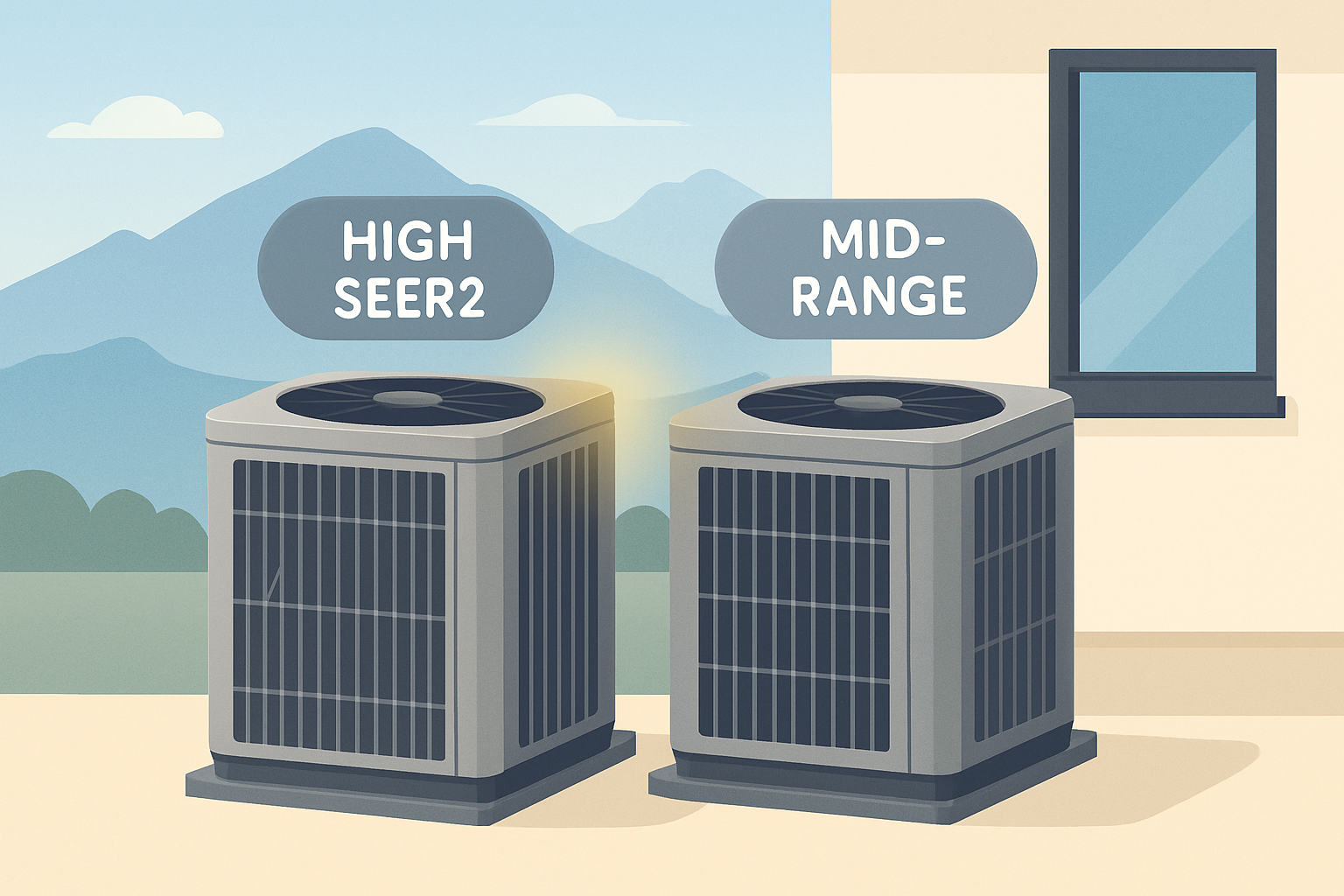
Summer utility bills in Colorado Springs can climb fast, especially when an old AC is running longer than it should just to keep up with dry heat, afternoon sun, and big temperature swings. The instinct is to shop for the highest efficiency number you can find, but that is not always the smartest move. The best high-efficiency HVAC units Colorado Springs homeowners buy are the ones sized correctly, matched to the home, and chosen for how Front Range weather actually behaves.
What high-efficiency options do you offer? The best options are right-sized high-efficiency central AC systems, heat pumps, and matched furnace/AC combinations selected for the home’s square footage, ductwork, usage patterns, and Colorado Springs climate. In most homes, the biggest summer savings come from upgrading from an older low-SEER unit to a properly installed SEER2-rated system in the mid-to-high efficiency range, not from chasing the absolute highest rating available.
How SEER2 really translates into summer savings
SEER2 is the efficiency rating that tells you how much cooling you get for the electricity you use. Higher is better, but the jump in savings usually gets smaller as the number goes up. For most homeowners, the useful question is not “What is the highest SEER2?” but “What level gives me a real return before the premium price gets too steep?”
Here’s the practical version. Replacing a very old system with a modern base-efficiency unit can cut cooling costs noticeably. Moving from a basic replacement into the mid-efficiency range often delivers the best balance of up-front price and monthly savings. Very high SEER2 equipment can save even more, but the payback only makes sense if you cool the home a lot, own the property long enough to benefit, and have the right ductwork and installation quality to support it.
The high-efficiency equipment categories that matter most
Not every upgrade works the same way. The main high-efficiency HVAC units Colorado Springs homeowners should compare usually fall into three categories:
High-efficiency central air conditioners. These are the most familiar summer upgrade. They pair best with homes that already have reliable ductwork and a furnace that still has years left in it. Upgrading from an older unit to a higher-SEER2 AC can reduce cooling costs, especially if the old system was oversized, loud, or short-cycling.
Heat pumps. A modern heat pump cools in summer and heats in milder weather. For some Front Range homes, this is a smart way to improve year-round efficiency. They are especially attractive if the homeowner wants one system to do more work and reduce gas use during shoulder seasons.
Matched furnace and AC replacements. If the furnace and air conditioner are both aging, replacing them together can improve compatibility, airflow, and efficiency. A matched system is often the cleanest path to better comfort, fewer repairs, and lower summer energy use.
Myth: The highest SEER2 system is always the best investment.
Reality: The best value usually comes from the highest efficiency level that fits the home’s usage, ductwork, and budget. A right-sized mid- to high-efficiency system often saves more in practice than an oversized premium unit that cycles too fast or costs more than it can ever earn back.
Where savings usually justify the upgrade cost
This is where homeowners can make a smart financial decision instead of an emotional one. In many Colorado Springs homes, the payback for a high-efficiency upgrade makes the most sense in these situations:
When the current system is old. If your AC is near the end of its life, every repair dollar is a dollar not going toward lower operating costs. Efficiency gains have more value when they replace a system that is already wasting energy.
When cooling demand is high. Homes with long afternoon sun exposure, finished upper floors, or frequent summer occupancy see more use, which gives efficient equipment more chances to pay back.
When ductwork is in good shape. A high-SEER2 unit cannot overcome major air leaks, bad airflow, or poor sizing. If the ducts are solid, the savings are more likely to show up.
When the homeowner plans to stay put. The longer you own the home, the more likely you are to recover the premium for higher-efficiency equipment through lower utility bills and fewer comfort complaints.
As a rule of thumb, the sweet spot is often a system that offers a meaningful step up from the old unit without paying for efficiency you will rarely use. That is why high-efficiency HVAC units Colorado Springs buyers should compare are best judged by return on investment, not the spec sheet alone.
The most expensive mistake is buying the wrong size
An oversized system cools the house too quickly, shuts off before it dehumidifies well, and can wear itself out from short cycling. An undersized system runs too long and may never quite catch up on hot afternoons. Either way, the “high-efficiency” label does not save you if the unit is the wrong size for the home.
Why Colorado Springs and the Front Range change the equation
Colorado Springs is not a humid, flatland cooling market. The Front Range gives you intense sun, lower humidity, rapid evening cooldowns, and elevation that changes how systems perform. That matters when choosing equipment.
Because evenings cool off faster here, many homes do not need the same extreme cooling capacity that a hotter, more humid climate would require. At the same time, strong sun and attic heat gain can overload a weak system during the hottest part of the day. The answer is not always a bigger unit. It is a system that can handle peak load without overshooting the mark.
For this climate, a properly selected mid- to high-efficiency system often makes more sense than chasing ultra-premium efficiency. The home gets better comfort during the hottest hours, and the owner avoids paying for features that do not deliver much extra value in a dry mountain climate.
"A good HVAC upgrade should fit the house first and the brochure second."
What a right-sized efficiency upgrade usually looks like
When homeowners ask about high-efficiency HVAC units Colorado Springs contractors recommend, the real answer should start with the home itself. A proper recommendation comes from load calculations, duct evaluation, insulation and window review, and a look at how the household actually uses cooling.
Before you choose an efficiency level, check these items
- Current system age and repair history
- Square footage and number of stories
- Insulation quality and sun exposure
- Duct condition and airflow balance
- How long the home stays occupied during summer
- Whether you plan to keep the furnace or replace both pieces together
That checklist matters because a system can only be as efficient as the home allows it to be. If the attic is heat-soaked, the ducts leak, or the unit is too large, the rating on the sticker will not translate into the savings on the utility bill.
How to think about efficiency ranges without overbuying
Most homeowners do best looking at efficiency in tiers instead of chasing a single perfect number. A lower replacement tier can make sense for a short-term fix or rental property where budget is the priority. A mid-range high-efficiency system often gives the best blend of cost and savings for owner-occupied homes. A higher-tier system can be worthwhile when the home has heavy cooling demand, long-term ownership, or especially poor current performance that a major upgrade can solve.
In other words, the best system is not the one with the biggest label. It is the one that reduces waste, keeps the house comfortable on hot afternoons, and pays back in a time frame the homeowner can live with.
In Colorado Springs, the first stretch of hot days often exposes weak systems before the real summer heat peaks. Homes near broad-sun exposures, upper-level bedrooms, and older neighborhoods with mixed duct conditions tend to feel that strain first, which is why a local load-based recommendation matters more here than a one-size-fits-all sales pitch.
Marcus Bell's Insights
I’ve seen plenty of homeowners get talked into the biggest, priciest system in the truck line, and then they’re surprised when the bill is still high or the comfort still isn’t right. The fix usually starts with the basics: Is the house actually the right size for the unit, are the ducts moving air properly, and does the cooling load make sense for Colorado Springs? That’s where the real savings come from. A solid mid-efficiency upgrade in the right home can beat a premium system that was installed to impress somebody on paper.
Frequently Asked Questions
What SEER2 rating is worth it for most homes?
For many homes, the best value is in the mid- to high-efficiency range rather than the absolute top tier. The right target depends on the home’s size, usage, and current equipment age.
Do heat pumps make sense in Colorado Springs?
They can, especially for homeowners who want efficient cooling and better performance in moderate weather. They are worth evaluating on a home-by-home basis.
Will a higher-efficiency unit always lower my bill a lot?
No. Savings depend on runtime, duct quality, sizing, and how much the system is actually used. A poor install can erase much of the benefit.
Is it better to replace the AC or the furnace and AC together?
If both systems are old, replacing them together often improves compatibility and may deliver better overall performance. If the furnace still has life left, a matched AC upgrade may be enough.
How do I know if my home is a good candidate for high-efficiency HVAC units Colorado Springs homeowners are choosing?
If your current system is aging, your summer bills are climbing, and your home has solid ductwork or clear opportunities to improve airflow, it is worth a right-sized efficiency consultation.
Get a Right-Sized Efficiency Recommendation
If you want the best summer savings, start with the home, not just the equipment label. Summit Comfort Heating & Air can help you compare high-efficiency HVAC units Colorado Springs homeowners can actually benefit from, with a recommendation based on your home size, usage, and Front Range climate needs.
Request your efficiency consultation with Summit Comfort Heating & Air