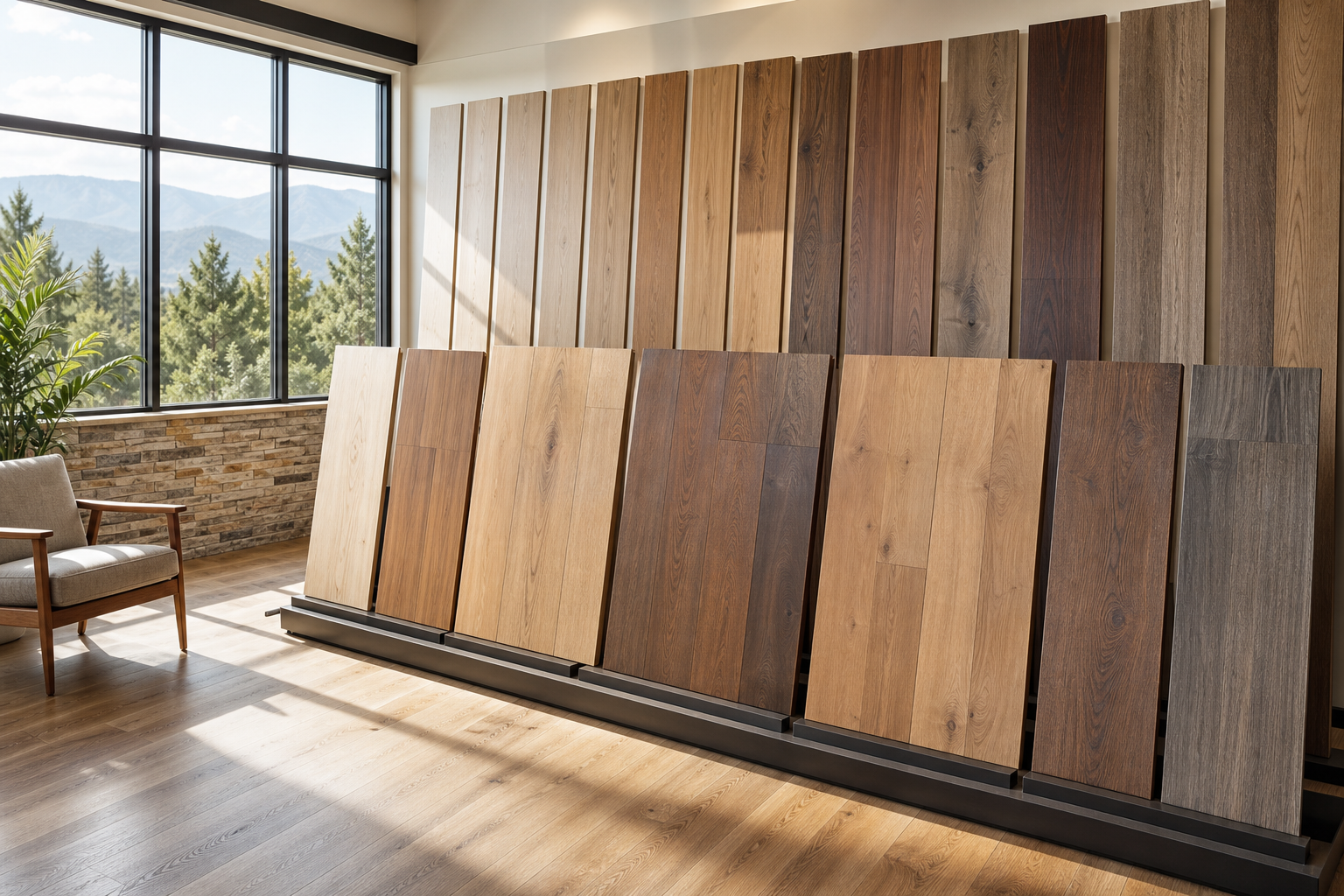
Does board width affect how hardwood performs in Colorado's dry climate? Yes, it does, and in Colorado Springs I see that question come up all the time once homeowners start comparing samples. A wide plank can be beautiful, but long-term hardwood performance here depends on how width, wood species, indoor humidity, and normal seasonal movement all work together, not just what the product is called on the label.
Yes. Hardwood board width affects how flooring performs in Colorado's dry climate because wider boards show seasonal shrinking and expansion more noticeably than narrower boards. That does not make wide boards bad, but it does mean species choice, room conditions, acclimation, and realistic appearance expectations matter more in Colorado Springs.
Does board width affect how hardwood performs in Colorado's dry climate?
Yes. Wider hardwood boards usually show more visible seasonal movement than narrower boards in dry climates like Colorado Springs. Over time, that can mean slightly larger gaps in winter, more noticeable cupping risk if moisture changes sharply, and a greater need to match the floor to the room’s real conditions.
This is the heart of the hardwood board width Colorado Springs conversation. The board itself is not failing just because you notice a winter gap. Wood is hygroscopic, which means it takes on and releases moisture from the air. In a place with low humidity, high altitude, forced-air heat, and strong seasonal swings, that movement becomes part of the long-term picture.
The National Wood Flooring Association, or NWFA, notes that wood flooring expands as it gains moisture and contracts as it loses moisture. That movement is normal and expected. In practical terms, a 5-inch board has more total width to shrink across than a 2 1/4-inch strip, so the visual change is often easier to spot.
- Narrower boards tend to spread movement across more seams, so seasonal change can look less dramatic.
- Wider boards can create a cleaner, more open look, but each individual seam may show seasonal change more clearly.
- Very dry interiors make both situations more noticeable.
I tell folks this all the time. A beautiful sample in your hand is only half the story. The other half is how that floor will live in your house in January and July.
In Colorado Springs, Colorado, homes from Briargate to Broadmoor often run dry in winter because of furnace heat and our naturally low humidity. That is one reason hardwood board width Colorado Springs buyers choose should be discussed with someone who understands local indoor conditions, not just showroom lighting.
How do wider boards change what homeowners should expect over time?
Wider boards change expectations more than they change basic wood behavior. The wood still moves seasonally, but the movement is easier to see. Homeowners who choose wider planks should expect some winter gapping and a more natural, lived-in look instead of expecting a perfectly unchanged floor year-round.
That expectation piece matters. Summer remodeling is popular in Colorado Springs because school is out, schedules are easier, and many families want projects done before fall. But installing in summer does not cancel out winter movement. It just means the floor will continue finding its balance as the seasons change.
Here is a simple weak-versus-strong way to think about it:
- Weaker expectation: “These wide boards should stay tight forever.”
- Stronger expectation: “These wide boards may show seasonal spacing, and that can still be normal if the floor was chosen and installed correctly.”
The U.S. Environmental Protection Agency says indoor relative humidity for comfort is often kept in a range that helps reduce problems associated with very dry air, and many wood flooring professionals aim for stable indoor conditions rather than extremes. In dry winter conditions, even a well-installed floor can show movement.
That is why hardwood board width Colorado Springs shoppers choose should line up with their tolerance for visible seasonal change. If tiny winter gaps will bother you every year, that is worth saying out loud before you buy.
Common mistake: buying by look only
A wide, pale oak sample may be the favorite in the showroom, but if the room gets full afternoon sun, has a wall of south-facing windows, and the house runs very dry all winter, the smarter question is not just “Do I like this look?” It is “Am I comfortable with how this look changes naturally over time?”
How does wood species hardness affect hardwood longevity in Colorado Springs?
Species hardness affects how a floor resists dents and wear, but hardness alone does not control seasonal movement. In Colorado Springs, the best long-term result usually comes from balancing dent resistance, grain character, and dimensional behavior with the household’s real traffic, pets, kids, and moisture conditions.
Homeowners often focus on the Janka hardness rating, and that is useful. For example, the U.S. Forest Service Forest Products Laboratory and industry references commonly list red oak around 1,290 on the Janka scale, hard maple around 1,450, and hickory around 1,820. Those numbers help compare resistance to denting.
But hardwood longevity is not just a hardness contest.
- Harder species can resist dents better in busy homes with pets and kids.
- Species with pronounced grain may hide small marks and everyday wear better.
- Lighter or cleaner visual grades can show gaps, scratches, or movement more easily.
- Very dense species still react to indoor moisture changes.
For a family in Falcon with a big dog and an active household, a harder species may make sense. For a rental property manager in Security-Widefield, a species and grade that visually forgives wear may be the better value. For an older home in central Colorado Springs, the house itself may tell you to avoid choices that demand perfectly steady humidity.
My honest advice after 40 years in the trade is simple. The toughest wood on paper is not automatically the best wood for your home.
Myth: A harder species means the floor will not gap, shift, or react to Colorado dryness.
Reality: Hardness mainly speaks to dent resistance. Seasonal movement is more about board width, species characteristics, installation conditions, and indoor humidity over time.
What seasonal movement is normal for hardwood in Colorado Springs homes?
Normal seasonal movement includes small gaps during dry winter months and some closing back up as indoor moisture rises. Minor changes do not mean something went wrong. In Colorado Springs, the real goal is controlled, predictable movement, not no movement at all.
This is where homeowners can save themselves a lot of worry. Wood floors are not static materials. In winter, especially during stretches of furnace heat and low humidity, boards may shrink slightly. In spring and summer, some of that spacing can lessen.
Normal changes may include:
- Fine seasonal gaps between boards
- Slight variation from one room to another
- Subtle changes near exterior doors, sunny glass, or vents
- A lived-in appearance that softens the brand-new look
Abnormal conditions are different. Persistent standing moisture, extreme cupping, major buckling, or dramatic movement throughout the floor deserve inspection. But a homeowner should not confuse every small winter gap with failure.
According to the NWFA, maintaining indoor humidity in a stable range is one of the most important ways to reduce excessive movement in wood flooring. In a dry-altitude market like ours, that advice matters.
How should room conditions guide board width and species selection?
Room conditions should guide both width and species because sunlight, humidity swings, traffic, subfloor conditions, and household use all affect long-term appearance. A good hardwood choice in Colorado Springs is usually a match between the room’s behavior and the wood’s natural behavior.
This is where local guidance earns its keep. The same product can perform differently in two houses a few miles apart.
Think through these conditions before ordering:
- Humidity profile. Does the home stay reasonably stable, or does it get extremely dry each winter?
- Sun exposure. Rooms with large south or west-facing windows can see stronger heat and light swings.
- Traffic level. Entryways, kitchens, and family rooms may benefit from harder species or visuals that hide wear.
- Pets and kids. Busy homes often need practical grain character and realistic expectations about scratches.
- Room size and style. Wide boards can look great in open layouts, but should still fit the home’s climate conditions.
- Older versus newer construction. Older homes in Monument or central Colorado Springs may have different airflow and humidity patterns than newer builds.
If you are comparing hardwood board width Colorado Springs options, ask to review samples with local recommendations, not just color cards. A board that looks ideal in a display rack may not be the most forgiving choice for your specific room.
Bring this checklist to your sample comparison
- What is the average winter humidity in my home?
- Will I notice normal seasonal gaps, or will that bother me?
- Do I need better dent resistance, or better ability to hide wear?
- Which rooms get the strongest direct sun?
- Has my installer explained acclimation and normal seasonal movement clearly?
What should homeowners expect from acclimation and appearance changes?
Acclimation helps wood adjust to site conditions before installation, but it is not a magic fix for every future movement issue. In Colorado Springs, homeowners should expect acclimation to be part of the process, then still expect natural appearance changes as the floor settles into year-round living conditions.
Acclimation time varies by product, jobsite conditions, and manufacturer instructions. There is no honest one-size-fits-all number that fits every home. What matters is that the flooring and the home are checked properly before installation, not rushed because the calendar got tight during summer remodeling season.
Reasonable appearance changes over time can include:
- Color mellowing with light exposure
- Small seasonal gaps
- Minor texture changes as the floor settles in
- Wear patterns in favorite walking paths
What I do not like seeing is a homeowner being promised that wood will look frozen in time. It will not. Good hardwood ages. The goal is for it to age honestly and well.
John Hughes's Insights
I have lived and worked in Colorado Springs for more than 40 years, and I can tell you the best hardwood jobs usually start with a plain conversation, not a sales pitch. I want to know how you live in the house. Do you run the heat hard all winter? Do you have dogs launching off the couch? Is this a formal dining room or the room where everybody drops backpacks and groceries? Those details matter more than a fancy product name. I also tell customers not to judge a floor only on day one. A real wood floor changes a little with the seasons, and that is part of its character. If we match the board width, species, and room conditions honestly from the start, you have a much better shot at loving that floor five or ten years from now.
Frequently Asked Questions
Does wider hardwood always perform worse in Colorado Springs?
No. Wider hardwood does not automatically perform worse. It usually shows seasonal movement more visibly, so success depends on species choice, indoor humidity, acclimation, and realistic expectations.
Is a harder species always the best choice for families?
No. Harder species can help with dents, but grain pattern, finish appearance, and how much movement or wear you notice also matter for busy homes.
Can summer installation prevent winter gaps?
No. Summer installation does not eliminate winter shrinking. Wood still responds to indoor humidity changes through the year.
How do I compare hardwood samples the right way?
Compare width, species, grain, and color together, then ask for local guidance based on your room conditions in Colorado Springs. That is much better than ordering by product name alone.
What is a normal look for hardwood after a few years?
Normal can include slight color change, small seasonal gaps, and visible traffic patterns in busy areas. Those changes are part of real wood living in a real home.
Compare hardwood samples with local guidance before you order
If you are sorting through hardwood board width Colorado Springs choices and want honest advice about width, species, acclimation, and what the floor will really look like over time, O'Briens Carpet One Floor & Home can help. Book a free in-home flooring measure and consultation to compare samples in your actual space with a local Colorado Springs flooring expert.
Schedule your free in-home flooring consultationExplore more, or reach out directly to O'Briens Carpet One Floor & Home in Colorado Springs, CO.