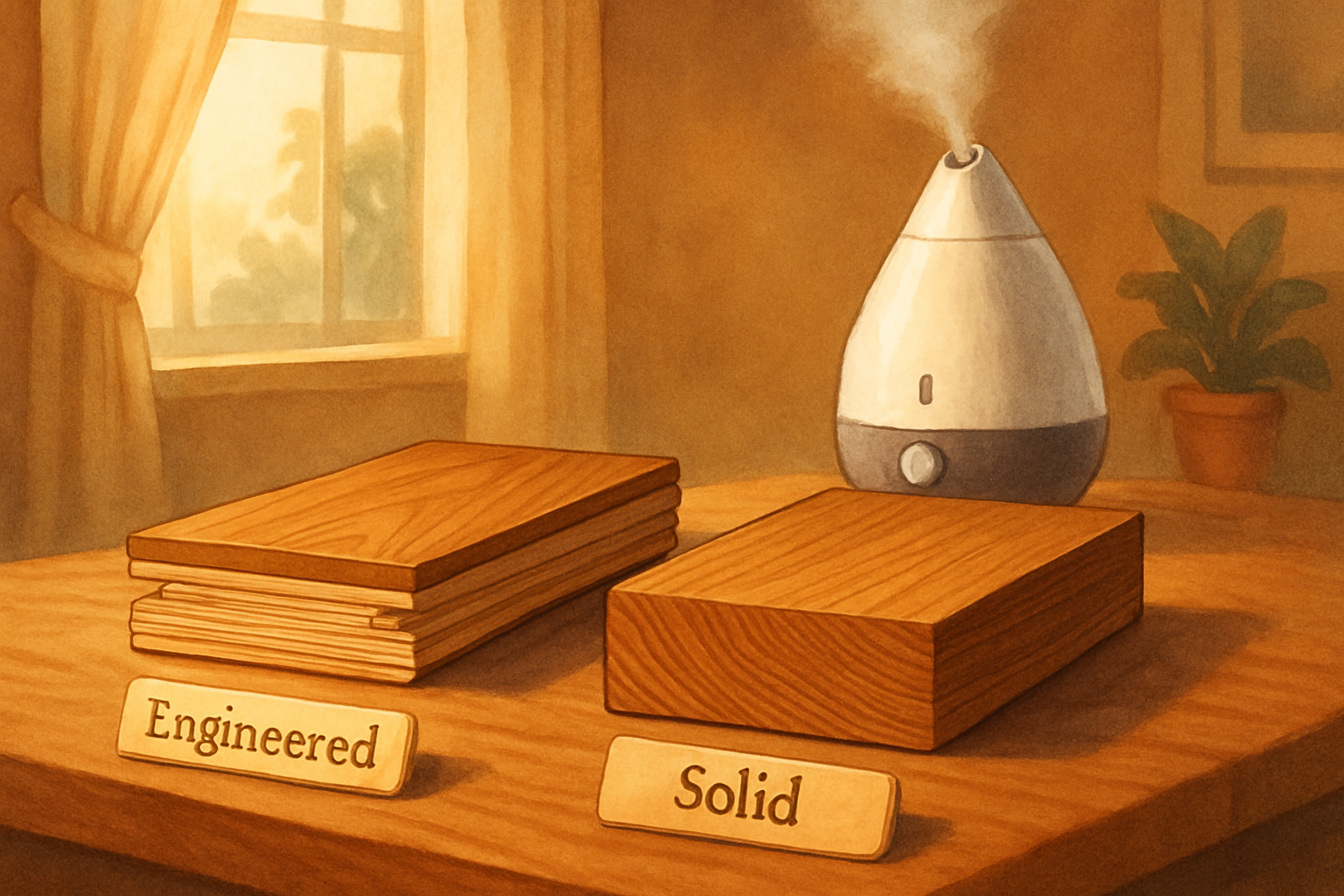
Summer is when a lot of Colorado Springs homeowners finally tackle the flooring project they put off through ski season and spring storms. Kids are out of school, schedules open up a little, and dry weather makes remodeling feel easier to manage. But hardwood choices made in July still have to survive January, and that is where the real decision starts. If you are searching for the best hardwood flooring for Colorado Springs climate, the construction of the board matters just as much as the wood species on top.
The best hardwood flooring for a home's climate in Colorado Springs is the product that matches our low humidity and seasonal moisture swings. In many homes, engineered hardwood holds up better because it moves less as indoor air gets dry, but some solid hardwood performs very well too if board width, species, and room conditions are chosen carefully. A free in-home measure is the safest way to match the floor to the space.
What is the best hardwood flooring for a home's climate in Colorado Springs?
The best choice is usually a climate-appropriate engineered hardwood or a carefully selected solid hardwood installed in the right room with the right board width and species. Colorado Springs is dry, and that dryness makes wood shrink, gap, and shift more than many national articles admit.
I have been helping families with flooring in Colorado Springs for more than 40 years, and one thing I have learned is simple. Hardwood does not fail here because wood is a bad product. It usually fails because somebody bought the wrong construction for the house, the room, or the humidity pattern.
Colorado's front range climate is not steady. According to the U.S. Environmental Protection Agency, indoor relative humidity is often recommended in the range of 30 percent to 50 percent for comfort and health. In Colorado Springs homes, especially in winter, indoor humidity can fall below that if the furnace runs hard and no humidification is used. The National Wood Flooring Association also notes that wood flooring performs best when the home is kept in a consistent living environment, commonly around 30 percent to 50 percent relative humidity.
That matters because hardwood is hygroscopic. It takes on and releases moisture with the air around it. In practical terms, lower humidity means boards shrink. Higher humidity means boards expand.
Here in Colorado Springs, I see the biggest hardwood movement issues after the first sustained cold snap, especially in homes in Briargate, Monument, and Falcon where winter indoor air can get very dry. Summer installation is common locally, but the floor still needs to be selected for what happens in January and February.
How do engineered and solid hardwood move differently in Colorado's dry air?
Engineered hardwood usually moves less than solid hardwood because its layered construction helps resist seasonal expansion and shrinkage. Solid hardwood is one piece of wood all the way through, so it reacts more directly to low humidity and can show wider gaps or more cupping if conditions swing hard.
This is the core comparison homeowners need to understand.
- Solid hardwood is milled from a single piece of wood. It can be sanded multiple times and has a long track record, but it expands and contracts more across the width of each board.
- Engineered hardwood has a real hardwood wear layer on top of a layered core, often plywood-based. That cross-layered build helps reduce movement caused by changing moisture levels.
Reduced movement is a big deal in our market. In a dry Colorado Springs winter, a wide solid plank may develop more visible gaps than a narrower solid plank of the same species. An engineered version of that same look often stays more stable.
I tell people this all the time. The prettier the wide plank sample looks under showroom lighting, the more disciplined we need to be about whether it fits your house.
What humidity levels should Colorado Springs homeowners expect, and why do they matter?
Expect dry indoor air for much of the year, especially during winter heating season, and expect seasonal swings between summer and winter. Those swings matter because hardwood movement is driven more by changing moisture conditions than by the calendar on the wall.
Colorado Springs has a semi-arid climate, and the altitude adds to the challenge. Outdoor humidity can be low year-round, but what really affects your floor is indoor relative humidity after your HVAC system, insulation, sun exposure, and daily living patterns do their work.
In real homes, room conditions can vary a lot:
- South-facing rooms with big windows often dry out faster.
- Homes with whole-house humidifiers tend to be easier on solid hardwood.
- Basements can be steadier than upper levels, but slab conditions still matter.
- Kitchens near exterior doors can see more moisture change than bedrooms.
- Vacant properties and rentals often have less consistent climate control.
According to the National Wood Flooring Association installation guidance, maintaining normal living conditions before, during, and after installation is essential for wood flooring performance. That is one reason a local evaluation matters so much more than generic national advice.
Common mistake: buying for the sample board, not the house
A weak approach is choosing a 7 inch solid hickory plank because it looks great on the display and assuming any hardwood will act the same in Colorado Springs. A stronger approach is checking winter humidity history, subfloor type, sun exposure, board width, and species movement before deciding whether that look should be solid hardwood, engineered hardwood, or a different width entirely.
Which species and board widths hold up better in low humidity?
Narrower boards and more dimensionally stable species usually handle Colorado's dry conditions better than very wide boards and species known for higher movement. This does not mean wide planks or active species are off the table, but they need more care in product selection and room matching.
Species matters because some woods move more than others as moisture changes. White oak is often a strong candidate in Colorado Springs because it is generally more stable than some other popular options and works well in both traditional and modern homes. Hickory is beautiful and hard, but it can be more reactive. Maple can also be less forgiving in certain conditions.
Width matters just as much. The wider the board, the more total visible movement you may see across that plank.
As a practical guide:
- Narrow to medium widths, often around 2.25 to 4 inches, tend to be more forgiving in solid hardwood.
- Wide planks, especially 5 inches and up, often make more sense in engineered construction for Colorado Springs homes.
- Long, wide boards create a beautiful look, but they leave less room for error if humidity drops hard.
I would rather talk a homeowner out of a risky floor today than hear about winter gaps they hate six months from now.
What to compare before you buy hardwood in Colorado Springs
- Current and winter indoor humidity levels
- Solid or engineered board construction
- Board width and length
- Species stability, especially for wide planks
- Subfloor type, wood or concrete
- Sun exposure and room-to-room moisture swings
- Whether pets, kids, and heavy traffic call for a tougher finish
- Manufacturer humidity guidelines and installation requirements
When should families in Colorado Springs prioritize engineered hardwood?
Families should usually lean toward engineered hardwood when they want wider planks, have variable indoor humidity, live over concrete, or need a floor that can better handle real-life traffic from kids, pets, and busy schedules. It is often the safer choice for homes where conditions are not perfectly controlled.
That does not make engineered the winner in every house. It makes it the smarter option in many Colorado Springs situations:
- You want a wide-plank look. Engineered often gives you that style with less seasonal movement.
- Your home gets very dry in winter. Less movement can mean fewer visible gaps and callbacks.
- You are installing on or below grade. Engineered is often better suited for concrete subfloors and basements, subject to product specs and moisture testing.
- You have an active household. Good engineered products with a quality wear layer and finish can be a practical fit for pets and kids.
- You own a rental or manage property. Consistency is not always perfect in these homes, so stability matters.
For a value-conscious family, engineered hardwood can sometimes prevent costly disappointment, even if the upfront price is not the absolute lowest.
Myth: Solid hardwood is always better because it is "real wood."
Reality: Both solid and engineered hardwood use real wood. In Colorado Springs, the better floor is the one that matches the home's humidity pattern, subfloor, and board size. A well-chosen engineered floor can outperform a poorly chosen solid floor in our dry climate.
John Hughes's Insights
I have spent more than four decades looking at floors in lived-in houses, not just on showroom racks, and Colorado Springs has taught me to respect dry air. Families come in wanting one answer, solid or engineered, and I do not give them a canned speech because that is how people end up with the wrong floor. I want to know if the house has a humidifier, if the dog bowl is always by the patio door, if the upstairs gets afternoon sun, and if the homeowner wants 3 inch planks or 7 inch planks. Those details decide more than the label does. Good hardwood is a long-term purchase. My job is to tell you the truth about what your home will actually support, even if that means steering you away from the sample you first liked.
"In Colorado Springs, the right hardwood construction matters as much as the species. Dry air does not care what looked best under showroom lighting." , John Hughes
Can solid hardwood still be the best hardwood flooring for Colorado Springs climate in some homes?
Yes, solid hardwood can absolutely be the right choice in Colorado Springs if the house maintains stable indoor humidity, the product width and species are chosen carefully, and the installation conditions are right. It is not outdated, and it is not automatically risky.
Solid hardwood often makes sense when:
- The homeowner prefers a traditional narrower plank look.
- The main level has a wood subfloor, not concrete.
- The home has good humidity control year-round.
- The chosen species is a better fit for local conditions.
- Long-term refinishing potential is a top priority.
This is why I do not like blanket claims. Some national articles act like engineered is always the modern answer or solid is always the premium answer. Neither statement helps a homeowner in Colorado Springs, Colorado make a sound decision.
The best hardwood flooring for Colorado Springs climate might be solid white oak in one house and engineered white oak in the next house across town. The difference is usually the room conditions, the board width, and how that home lives through winter.
What should happen before choosing hardwood for a Colorado Springs home?
A free in-home measure should happen before the final hardwood decision because that is when humidity, room conditions, subfloor type, and layout details can be evaluated against the product. That step often saves homeowners from buying a floor that looks right in the store but behaves badly at home.
At O'Briens Carpet One Floor & Home, this part matters. A real measure is not just about square footage. It should include:
- Reviewing the rooms that will get hardwood
- Discussing winter dryness and any humidification in the home
- Checking whether the subfloor is wood or concrete
- Looking at sunlight, entries, kitchens, and traffic patterns
- Matching your preferred look with a product construction that fits the home
If you are trying to narrow down the best hardwood flooring for Colorado Springs climate, that home visit gives you the facts you need to buy with confidence instead of guessing from a sample board.
Frequently Asked Questions
Is engineered hardwood better than solid hardwood in Colorado Springs?
Often, yes, especially for wide planks, concrete subfloors, and homes with low winter humidity. But solid hardwood can still be an excellent choice in homes with stable conditions and the right species and width.
What wood species is usually a safer bet in Colorado's dry climate?
White oak is often a strong option because of its relative stability and broad design appeal. The final choice still depends on board width, product construction, and room conditions.
Do hardwood floors always gap in winter in Colorado Springs?
Some seasonal gapping can be normal because wood shrinks as indoor air gets drier. The goal is to choose a floor and maintain a home environment that keeps movement within an expected range.
Can I install solid hardwood in a basement?
In many cases, engineered hardwood is the more practical option over below-grade areas or concrete, depending on moisture testing and manufacturer guidelines. Solid hardwood is usually less forgiving there.
How do I know the best hardwood flooring for Colorado Springs climate for my house?
You need the product matched to your actual home conditions, not just your style preference. A free in-home measure is the best way to evaluate humidity patterns, subfloor, room exposure, and board options before you buy.
Find the best hardwood flooring for Colorado Springs climate before you buy
If this article helped you compare engineered and solid hardwood for Colorado Springs' dry climate, the next step is simple. Let a local flooring expert evaluate your humidity, subfloor, sunlight, and room conditions in person so you can choose the right hardwood construction for your home, your family, and your budget. Book your free in-home flooring measure and consultation with O'Briens Carpet One Floor & Home at https://www.obrienscarpetone.com.
Book a free in-home measureExplore more, or reach out directly to O'Briens Carpet One Floor & Home in Colorado Springs, CO.