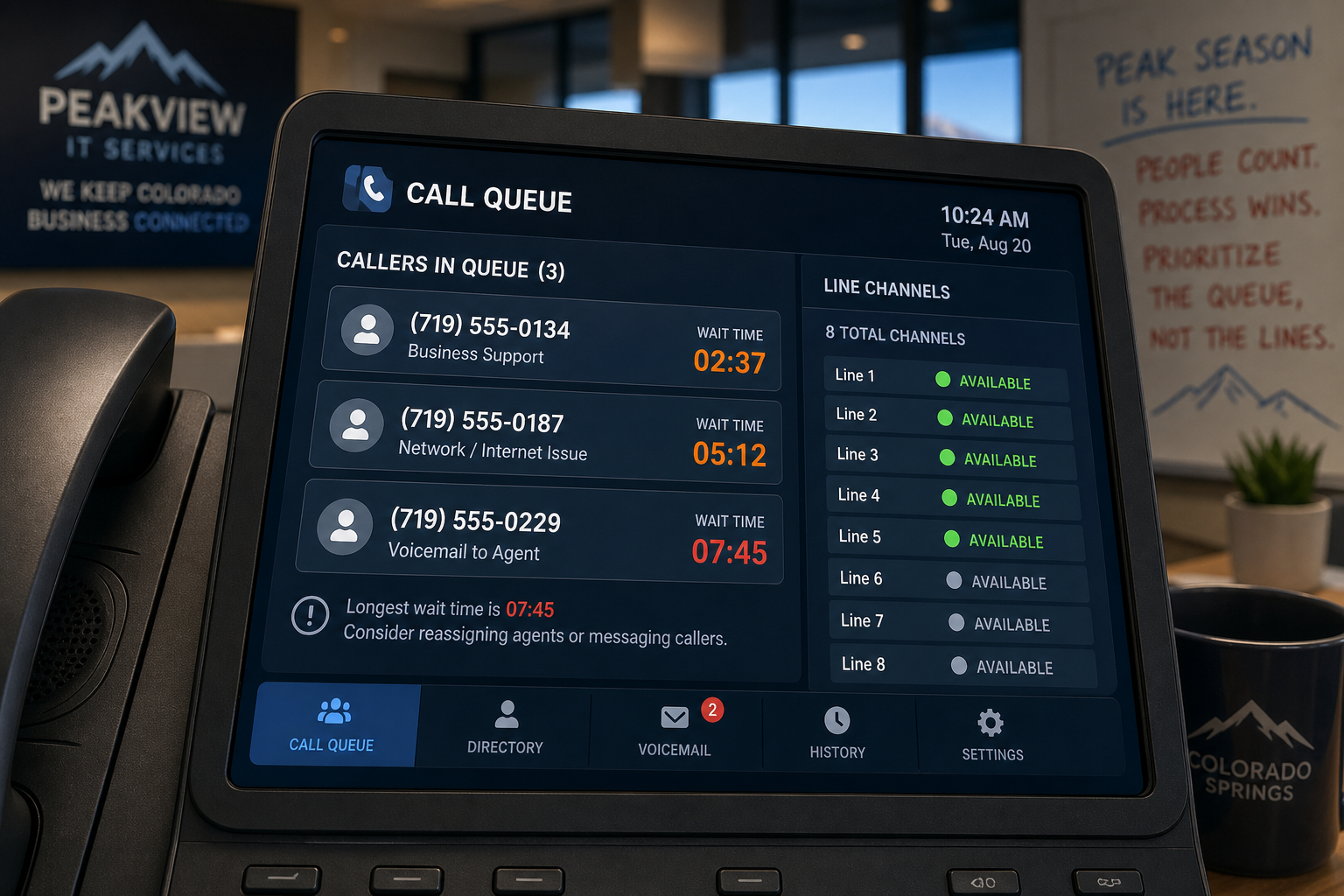
It is a familiar late summer pattern in Colorado Springs. The phone starts ringing harder in the last weeks before Labor Day, a few customers call at the same minute, and the owner assumes the fix is simple. Add more lines. Then the business adds capacity, sees no busy signal, and still watches good callers slide to voicemail because every employee who can answer is already on another call.
A small business should use a call queue instead of adding more phone lines when the system can accept the call, but the team cannot answer it right away. Add lines when callers are blocked before the call enters the system. Add queueing when short bursts of simultaneous calls are overwhelming 1, 2, or 3 available people.
When should a small business use a call queue instead of adding more phone lines?
Use a queue when your phone system can accept the call, but your team cannot answer it right away. Add lines only when callers hear a busy signal, fail to connect, or your system is hitting its concurrent call limit before the call even reaches your staff.
This distinction matters because line capacity and answer capacity are different constraints. I see Colorado Springs businesses blend them together all the time, especially in service companies where 2 to 5 people share incoming calls while also doing field work, estimates, dispatch, or front desk tasks.
Here is the practical difference:
- Phone line problem: The system cannot accept another simultaneous call. Caller gets blocked.
- Call handling problem: The system accepts the call, but no one is free to pick it up. Caller waits, goes to voicemail, or abandons.
A business phone call queue is meant for the second case. It holds the caller in an orderly path, gives them status, and routes the call to the next available person instead of dropping them straight into voicemail just because everyone is occupied for 90 seconds.
For many local companies, that 90 second burst is the whole issue. You do not need to build a contact center to solve it. You do need to diagnose the bottleneck correctly. In my experience, most owners are not underbuilt on lines. They are underbuilt on what happens in the 60 to 180 seconds after a call gets through.
In Colorado Springs, late summer often brings these short spikes for HVAC, plumbing, restoration, auto service, home services, and medical offices. A storm on the north side, school-year scheduling changes, or event traffic around downtown can compress calls into a 10 to 20 minute window even if the full day volume looks normal.
What does the problem look like in a real Colorado Springs example?
The clearest sign is this. You have enough channels for incoming calls, but callers still do not reach a person because every available employee is already busy. That is a queueing problem, not a line problem.
Take a hypothetical Colorado Springs plumbing and drain company with these numbers:
| Item | Current setup |
|---|---|
| Incoming call capacity | 8 simultaneous channels |
| Employees who can answer new calls | 2 office staff |
| Average live call length | 4 to 6 minutes |
| Late summer spike | 5 callers within 3 minutes |
| Current overflow rule | Send to voicemail if both staff are busy |
At 10:12 a.m., 2 office staff are already on live calls. Then 3 more customers call in over the next 180 seconds. The system has room for all 5 calls. No channel is maxed out. No one hears a true busy signal. But callers 3, 4, and 5 cannot reach a person because the only 2 answerers are occupied.
If the system sends those callers straight to voicemail after 3 rings, the company may think, “We need more lines.” It does not. It already had 8 channels and only 5 active calls. The real issue is that the business has zero waiting path between “call accepted” and “person available.”
A small business phone call queue would let those 3 callers hold their place for a short period, hear a message, and move to the next free employee. If average handling time is 5 minutes, one staff member may free up at 10:14 and the next at 10:16. Two of those three callers might have been answered live with no staffing change at all.
Most businesses do not have a phone line shortage. They have a timing mismatch between call arrivals and available humans. I would rather prove that with 14 days of call logs than guess based on one hectic Monday morning.
What queue thresholds suggest a business phone call queue is justified?
A queue is usually justified when simultaneous calls create short answer delays often enough to cost real conversations. You do not need massive call volume. You need repeated moments where 2, 3, or 4 callers arrive before the next employee becomes free.
Useful thresholds for small and mid-sized businesses are practical, not fancy:
- Repeated overflow to voicemail during open hours. If live callers hit voicemail more than a few times per week because all answerers are busy, not because the office is closed, review queueing.
- Abandoned call rate rising during specific windows. Industry figures vary by call type, but Call Centre Helper commonly cites 5 percent as a planning target many operations try to stay under for abandoned calls. A small service business does not need to chase a contact-center benchmark, but if your abandoned rate is regularly above 5 to 8 percent during recurring peaks, that is worth fixing.
- Short bursts of 3 or more unanswered calls. If 3 callers arrive within 2 to 4 minutes and only 1 or 2 people can answer, a queue often helps more than additional lines.
- Average speed to answer is stretching past caller patience. Research from Invoca has reported that many callers expect quick response and will abandon or choose another business when they cannot reach a person promptly. Exact tolerance differs by industry, but once waits regularly move past 60 to 120 seconds, experience drops fast.
- Voicemail retrieval becomes the backup plan, not the exception. If your team is returning same-hour voicemails that should have been live answered, the system is not matching your call pattern.
You can also think in queue depth. For many smaller offices, a queue depth of 2 to 4 callers is enough. Beyond that, the better answer may be callback, schedule change, or a different routing rule. Queueing is not about making people wait forever. It is about absorbing short spikes intelligently.
What to check before you change anything
- How many simultaneous channels does the current phone system actually support, 4, 8, 12, or more?
- How many people can answer inbound calls during the busiest 30 minutes of the day?
- How many calls go to voicemail between opening and closing, while staff are actively working?
- What is the average live call length, 2 minutes, 5 minutes, or 9 minutes?
- How many callers hang up before reaching a person?
- Does the system offer queue announcements, estimated wait messaging, and callback without replacing the whole environment?
- Can you identify the top 2 recurring peak windows across the last 30 days?
- Do voicemail overflows happen because no one is free, or because the system is out of channels?
How long should callers wait, and what makes the hold experience acceptable?
Short waits can work if the caller knows what is happening. Long silent waits usually fail, even when the total wait time is not extreme.
A good hold experience for a small business is simple:
- Tell the caller they reached the right business.
- Tell them they are in line for the next available person.
- Give a realistic option to stay on hold or request a callback.
- Keep the messaging concise.
Here is a weak versus strong example from a buyer's point of view.
Weak: “All representatives are busy. Please continue to hold.” Then music for 2 minutes, no context, no alternative, and no sense that the call is actually progressing.
Strong: “Thanks for calling. We are helping other customers right now. Your call is in queue for the next available team member. If you prefer not to hold, press 1 for a callback and keep your place.”
That is a better use of a business phone call queue because it reduces uncertainty and gives the caller a clear next step. According to the American Express customer service research often referenced in service discussions, consumers strongly value responsive service and are quick to change providers after poor experiences. Even without a perfect universal wait threshold, the business lesson is plain. Silence feels longer than structure.
I would also keep the queue tight. For many local businesses, 30 to 90 seconds is a healthy target for routine spikes. If expected wait regularly exceeds 2 to 3 minutes, the answer may be callback-first routing or a process change, not just a longer hold. My rule is simple. If a caller cannot tell what is happening in the first 15 seconds, the queue message is not doing its job.
If your team is already reviewing broader communications decisions, these growth-stage communication features are a useful next reference point.
The common mistake
Businesses often buy more call capacity because it is easy to count lines and harder to measure answer flow. The result is 10, 15, or 20 channels feeding into the same 2 people, with voicemail still catching the overflow. More channels without queue logic can simply deliver failure faster.
When should callback options be part of the fix?
Callback should be part of the fix when hold times are unpredictable, when callers are often mobile, or when the business sees repeat spikes that last longer than a minute or two. It is especially helpful when a queue would otherwise become a parking lot.
Callbacks make sense in several conditions:
- Service dispatch offices where callers may be driving, at a jobsite, or between appointments.
- Medical and professional offices where callers may not want to sit on hold during work.
- Seasonal burst patterns such as end-of-summer demand, storm follow-up, or event-related traffic.
- Teams with only 1 to 3 answerers where one long call can distort the queue fast.
The key is to use callback with rules. If a callback request means “we will get to this sometime today,” that is not much better than voicemail. A better standard is a prompt return path, often within 5 to 15 minutes for active queue callbacks during business hours.
There is also an operations benefit. Callback lets you keep callers in a measurable workflow instead of losing them to voicemail boxes and sticky notes. If the business later adds automation, this kind of structured inbound flow becomes far easier to improve. QuByte Systems often starts with the phone issue in front of you, then helps leadership identify adjacent process fixes through its broader strategic IT work.
Why do abandoned and unanswered call metrics matter so much?
They matter because they reveal the real cost of the current setup. If you only count total calls, you can miss the calls that almost became customers. Measuring abandoned and unanswered calls is how you tell the difference between “busy day” and “broken call handling.”
Track at least these 6 metrics for 30 days:
- Total inbound calls
- Peak simultaneous calls
- Answered live calls
- Calls sent to voicemail during open hours
- Abandoned calls
- Average speed to answer
If possible, split those by time of day. Many Colorado Springs businesses learn that their problem is not all-day volume. It is one recurring 20 minute window, sometimes around 8:00 a.m., 11:30 a.m., or 3:30 p.m.
Here is a simple 4 step review I use for diagnosis:
- Export 30 days of call records from the phone system.
- Mark every call that hit voicemail during open hours.
- Compare those timestamps to how many people were actually available to answer.
- Check whether blocked calls ever exceeded your true channel count.
If step 4 rarely happens, adding lines is usually not the first fix. If steps 2 and 3 happen often, queueing or callback probably is.
This is where diagnosis matters. A vendor that jumps straight to “buy more lines” may not be wrong about capacity. They may just be solving the wrong problem first. QuByte Systems’ advantage is that it can inspect the phone environment, the network, and the actual call-handling workflow before recommending change. That same diagnostic mindset shows up in what proactive remote IT support looks like day to day. Measure first, then fix the constraint that is actually losing calls.
I would rather show a client 30 days of call evidence than make a confident guess in 30 seconds.
A quick note from QuByte Systems
When I look at a phone problem, I do not start by asking how many lines you have. I start by asking what happened to the caller at 10:12 a.m. on your busiest day. Did the call fail to enter the system, or did it enter just fine and then stall because your 1 or 2 available people were tied up? That one distinction saves businesses from buying the wrong fix all the time. In Colorado Springs, I see this most often in small service offices where weather, school schedules, or a single busy technician can compress normal demand into a 15 minute spike. My bias is to keep the solution simple. If a queue depth of 2 to 4 callers, a clear message, and a callback option solve the issue, that is better than overbuilding the phone system just because more channels sound safer.
Frequently Asked Questions
Can a small business use a call queue without buying contact-center software?
Yes. Many small businesses can add a simple queue, basic announcements, and callback options within a business phone system they already have or with a modest upgrade. You do not need a full contact-center stack to handle short bursts of simultaneous callers.
What is the first sign that more phone lines will not help?
The first sign is that callers are reaching the system but not reaching a person. If there are no true capacity failures, no blocked calls, and no busy signals, but callers still end up in voicemail because staff are occupied, the issue is queueing or workflow, not line count.
How many callers in queue is too many for a small office?
There is no universal number, but for many small offices a queue of 2 to 4 callers is manageable if the wait stays short. Once the queue regularly grows past that and callers are waiting more than 2 to 3 minutes, the business should review callback rules, staffing patterns, and call routing instead of just extending hold time.
Need help diagnosing whether you need lines or queueing?
QuByte Systems can review your current phone setup, identify whether the real constraint is channel capacity or live answer availability, and recommend the simplest fix for lost inbound calls. Book a discovery call and let us take this call-flow diagnosis off your plate. Beyond IT support. Engineering what comes next.
Book a discovery call