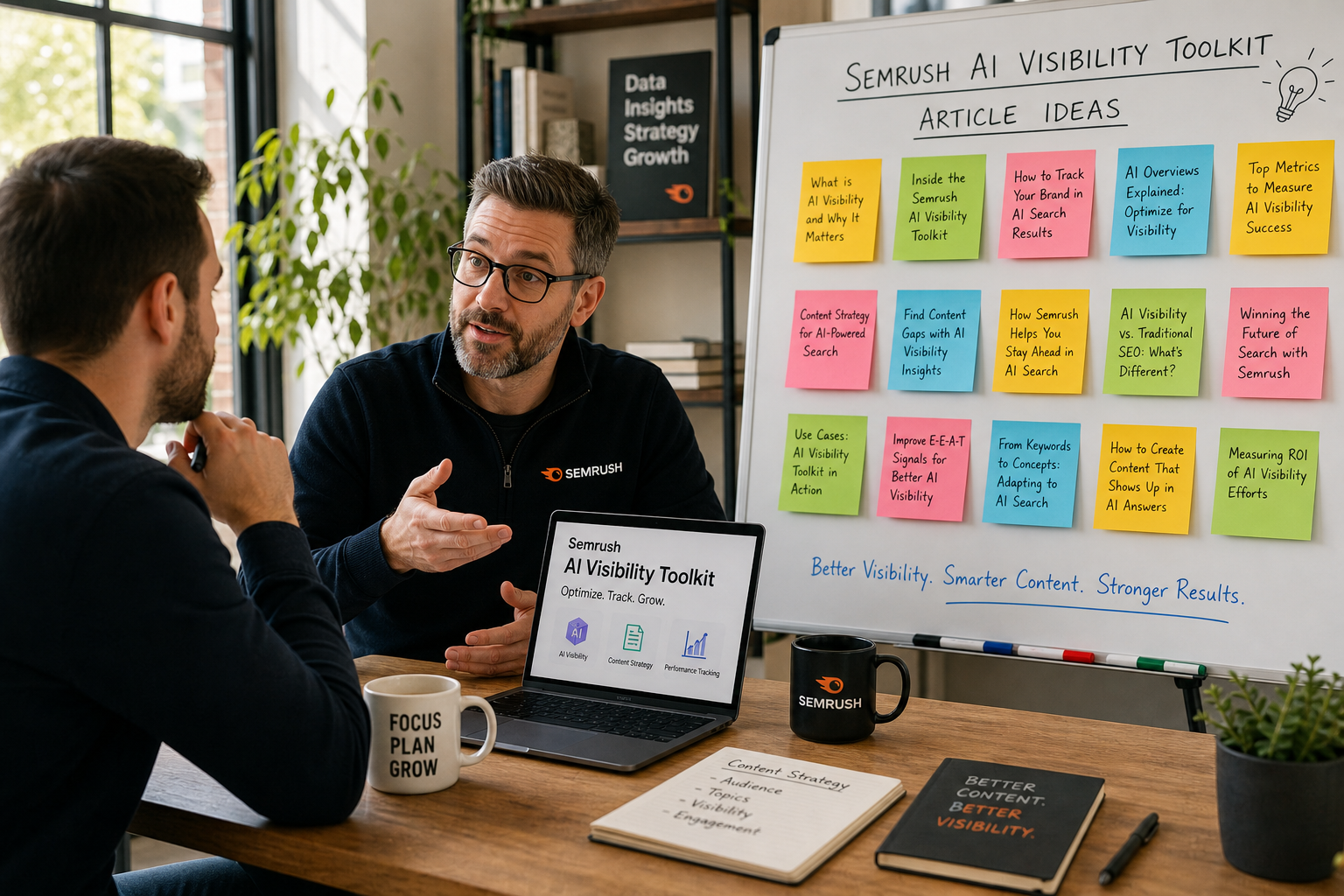
Buyers are getting answers from Google AI Overviews, ChatGPT, and Perplexity before they ever land on your site. If you are searching for semrush ai visibility toolkit, the practical question is simple. Will it help you measure where your brand shows up in AI answers, and will that be enough for your business right now?
What should I know before choosing semrush ai visibility toolkit? Know this first. Semrush appears to position it as an AI visibility measurement product, not a full done-for-you publishing system. If your main need is tracking prompts, mentions, competitors, and visibility trends, it may fit. If you also need the articles, posting, site publishing, and follow-up that create more chances to be cited, you will still need another system or team.
What should I know before choosing semrush ai visibility toolkit?
You should know exactly which job you are hiring it to do. The semrush ai visibility toolkit looks like a measurement and monitoring buy first. It is a weaker fit if what you really need is weekly execution across your site, blog, Google Business Profile, LinkedIn, Facebook, and email.
That sounds obvious, but this is where owners get stuck. They buy a dashboard while hoping they bought momentum. Those are different things.
Here is the clean way to think about it:
- If you need measurement: you are trying to see which prompts matter, where your brand appears, how competitors show up, and whether visibility improves over time.
- If you need execution: you are trying to turn what your team knows into publishable articles, local posts, FAQs, service-page improvements, and contact follow-up.
- If you need both: you need a scoreboard and a publishing engine. One without the other is usually where the waste starts.
I talk to a lot of owners who have already paid for rank trackers, audits, agency reports, and monthly reviews. Then I ask a blunt question. Can you point to 12 useful published articles from the last 12 months that answer real buyer questions in your voice? A surprising number cannot.
Before you book a demo, ask these 5 questions:
- What does it measure? Prompt coverage, brand mentions, competitor mentions, citation frequency, or some mix.
- What is prompt volume based on? If you are specifically searching semrush ai visibility products prompt volume or semrush ai visibility prompt volume, ask how Semrush estimates demand at the prompt level, how often that data refreshes, and whether it reflects search demand, AI platform behavior, or modeled demand.
- What does it not do? Writing, editing, approvals, site publishing, social distribution, and follow-up.
- What proof will move? Mention share, indexed pages, page-one keyword count, branded search lift, and examples of actual AI answer appearances.
- How much time does it need from your team? A tool that needs 3 to 5 hours a week from a busy owner often becomes shelfware by month 2.
According to Semrush, the company is built around online visibility and marketing workflow software. That matters. It suggests you should evaluate semrush ai visibility toolkit as software first, not as a service that automatically turns your expertise into finished content.
What is semrush ai visibility prompt volume, and why does it matter?
Prompt volume matters because it helps you tell the difference between a prompt that looks interesting and a prompt that could actually influence demand. If semrush ai visibility toolkit shows prompt volume, the real value is not the number alone. It is how you use that number to choose what to publish first.
This is one of the more important buyer questions coming into this page, so I want to answer it directly. If you are asking about semrush ai visibility products prompt volume or semrush ai visibility prompt volume, you are really asking three things:
- Does the platform estimate how often people ask a question or a close variant?
- Can I compare prompt demand across topics and competitors?
- Can I use that data to prioritize pages and articles that have a better chance of being surfaced?
If the answer to those is yes, then prompt volume is useful. But it still has limits.
Prompt volume is not the same thing as revenue potential. A smaller prompt can matter more if it sits closer to a buying decision. For example:
- Weaker topic: “What is dental sedation?”
- Stronger topic: “What dental sedation feels like during wisdom tooth extraction”
The second topic may have lower volume, but it is more specific, more quotable, and closer to a real appointment decision.
I would ask Semrush to show you this in a live example:
- A prompt with visible volume or modeled demand.
- The competing brands mentioned for that prompt.
- The pages or content types most likely connected to those mentions.
- How the product recommends acting on that data.
If all you get is a prompt list and a number, that is not enough. If you get prioritization help tied to real content gaps, that is more useful.
Google says through Google Search Central and Support that its systems aim to surface helpful, relevant content from across the web. That is the bigger point here. Demand data can point you toward the right questions, but your business still needs source material specific enough to be surfaced and cited.
What does semrush ai visibility toolkit cost, and what should you expect to pay?
You should expect sales-led pricing unless Semrush publicly posts a package by the time you check. If pricing is not transparent on the site, budget only after a demo, because the real cost includes both the software fee and the work still left for your team.
I am not going to invent a number, and you should be careful around articles that do. Ask for 4 plain answers:
- What is the monthly platform fee?
- Are there limits on prompts, brands, seats, or reports?
- How often does the data refresh?
- What work still has to be done outside the platform?
This last question matters most for small service businesses. A $300, $800, or $2,000 line item can be cheap if it removes manual research and improves decisions. The same spend can be expensive if you still need a strategist, writer, editor, publisher, and distribution owner to act on the findings.
For a cleaner comparison, put a software-only option next to an execution-included option. The plans at https://postedby.ai/pricing show what is bundled when the goal is weekly authority publishing, not just measurement.
| Decision factor | Visibility toolkit | Authority publishing system |
|---|---|---|
| Measures AI visibility | Usually yes | Should include it or pair with it |
| Tracks prompt-level opportunities | Often yes | Sometimes secondary |
| Writes weekly authority articles | Often no | Yes, if execution is included |
| Publishes to website and hosted blog | Often no | Should be included |
| Posts to Google Business Profile and social | Rarely the core job | Should be included |
| Email follow-up to contacts | Usually no | May be included |
I have a simple rule here. If you cannot tell where month-one output comes from, you do not have a marketing plan. You have another subscription.
What results should you expect from semrush ai visibility toolkit in month one versus month six?
You should expect faster measurement than business outcome. In month one, the value is baseline data, prompt coverage, and competitor gaps. By month six, the value should show up in stronger source material, more indexed proof content, and some evidence that your brand appears more often where buyers ask questions.
Reasonable expectations look like this:
- First 2 weeks: prompt set, competitor set, current mention share, and obvious gaps.
- First 30 days: prioritized topics, clearer pages to improve, and a decision on what to publish next.
- Days 30 to 90: new articles, FAQ expansion, better service-page specificity, and more complete coverage across channels.
- Months 4 to 6: more indexed content, some page-one keyword movement, and occasional appearances in AI-generated answers if the material is specific enough to quote.
According to Statista, ChatGPT reached about 400 million weekly active users by early 2025, based on OpenAI statements reported there. That does not mean every local buyer is replacing Google. It does mean answer engines are now part of the discovery path, which is exactly why visibility measurement is getting attention.
Here is my contrarian view. Most small businesses do not have an AI visibility problem first. They have a source-material problem. Thin pages. Generic blogs. No original examples. No local specifics. No useful follow-up content.
A family law firm in Phoenix that never appears for “child custody mediation timeline” learns something useful from a toolkit. But the score does not fix the issue. The fix is stronger pages and articles with process detail, realistic timelines, and the plain-English explanations people actually search for.
A dental office in Tampa might learn competitors show up for “Invisalign cost factors” and “what dental sedation feels like.” Good insight. Still not enough. You need material a nervous patient would trust and repeat back to a spouse.
From Colorado Springs, I see the same pattern across local markets. In spring and summer, roofers in hail-prone places like Dallas get sudden buyer demand around inspections and insurance questions. In late fall, HVAC and home-service companies in colder markets like Columbus see the opposite pressure around heating failures and emergency timing. The prompts change by season. The bottleneck usually does not. Owners know the answers, but those answers never get published in a form search and AI systems can reuse.
How do you choose between semrush ai visibility toolkit and a done-for-you alternative?
Choose based on your bottleneck. If your team already publishes consistently and you mainly need better AI visibility measurement, Semrush may make sense. If your team struggles to turn expertise into finished content every week, a done-for-you system is often the better first buy.
I would make the decision in 6 steps:
- Define the immediate job. Tracking, publishing, or both.
- Run a knowledge extraction test. Can someone turn a 20-minute owner conversation into an 800 to 1,200 word article you would actually approve?
- Check evidence quality. Does the output include examples, timing, process details, pricing context, and disclaimers where needed?
- Review distribution. Where does each piece go after publication? Website, hosted blog, GBP, LinkedIn, Facebook, and email are different jobs.
- Check ownership. Who owns the content, where it lives, and whether it can publish to your domain.
- Set a 180-day proof standard. What exactly should improve by month 6?
If you are trying to sort out the measurement side versus the answer-engine side, this breakdown of GEO vs AEO and what to know before you book is worth reading alongside this page.
Buyer checklist before you book
- Ask to see a sample report and a sample recommendation turned into a finished published asset.
- Ask what number should move in 30, 60, and 180 days.
- Ask how many minutes of owner time are needed each week. Good answers are usually under 30 minutes.
- Ask whether prompt volume is estimated, modeled, or directly observed, and how that should affect decisions.
- Ask who owns the content, where it is hosted, and whether it can publish to your website directly.
- Ask what happens if the visibility score drops. Is there a publishing response, or just another chart?
- Ask whether it replaces your agency retainer or simply adds another subscription.
A strong interview example makes this obvious. Weak extraction sounds like, “Tell us about your business.” Strong extraction sounds like, “What question do buyers ask right before they choose a cheaper competitor, and what do you wish they understood?” That one question can produce better authority content than 10 generic prompts.
If you want to see how I handle that part, the Champion process is built around answering a short set of real business questions once, then turning that into repeatable authority content.
When is semrush ai visibility toolkit not the right fit?
It is not the right fit when your business needs execution more than analysis, when nobody on your team can own weekly publishing, or when you need one topic turned into multi-channel content without babysitting the process.
That includes a lot of local service businesses. If calls and form fills are thinning out, another dashboard may not help much by itself. You may need the unglamorous work done well:
- Weekly authority article creation
- Brand voice setup
- Hosted blog publishing
- Website publishing integrations
- Google Business Profile posting
- LinkedIn posting
- Facebook posting
- Personalized Thursday outreach emails
That is the gap I built https://postedby.ai to fill. Not because dashboards are bad, but because most owners need the article, the post, the publishing, and the follow-up to actually happen.
If part of what pushed you into this search is the drop in clicks from AI summaries and no-click behavior, this explanation of zero-click search, costs, what to expect, and how to choose will help you pressure-test the bigger decision.
Frequently Asked Questions
Does semrush ai visibility toolkit replace SEO?
No. It should be treated as one part of the visibility stack, not the whole stack. SEO still includes technical site health, service-page quality, internal linking, entity clarity, local signals, and useful content strong enough to earn search visibility and AI citations.
Can semrush ai visibility toolkit help my business get cited by ChatGPT or Perplexity?
It may help you understand where you appear, where competitors appear, and which prompts matter. It does not mean you control those systems, and nobody credible should promise that. What improves your odds is better source material. Specific pages, quotable articles, local examples, plain answers, and content good enough that an answer engine can reuse it.
See how this is measured before you buy another visibility tool
If you are trying to decide whether semrush ai visibility toolkit gives you enough by itself, I will show you the difference between a score and a publishing system. We can walk through what gets tracked, what gets published, what gets indexed, and what proof actually moves week over week. Be the source AI cites.
Questions before you book? Talk with me here.