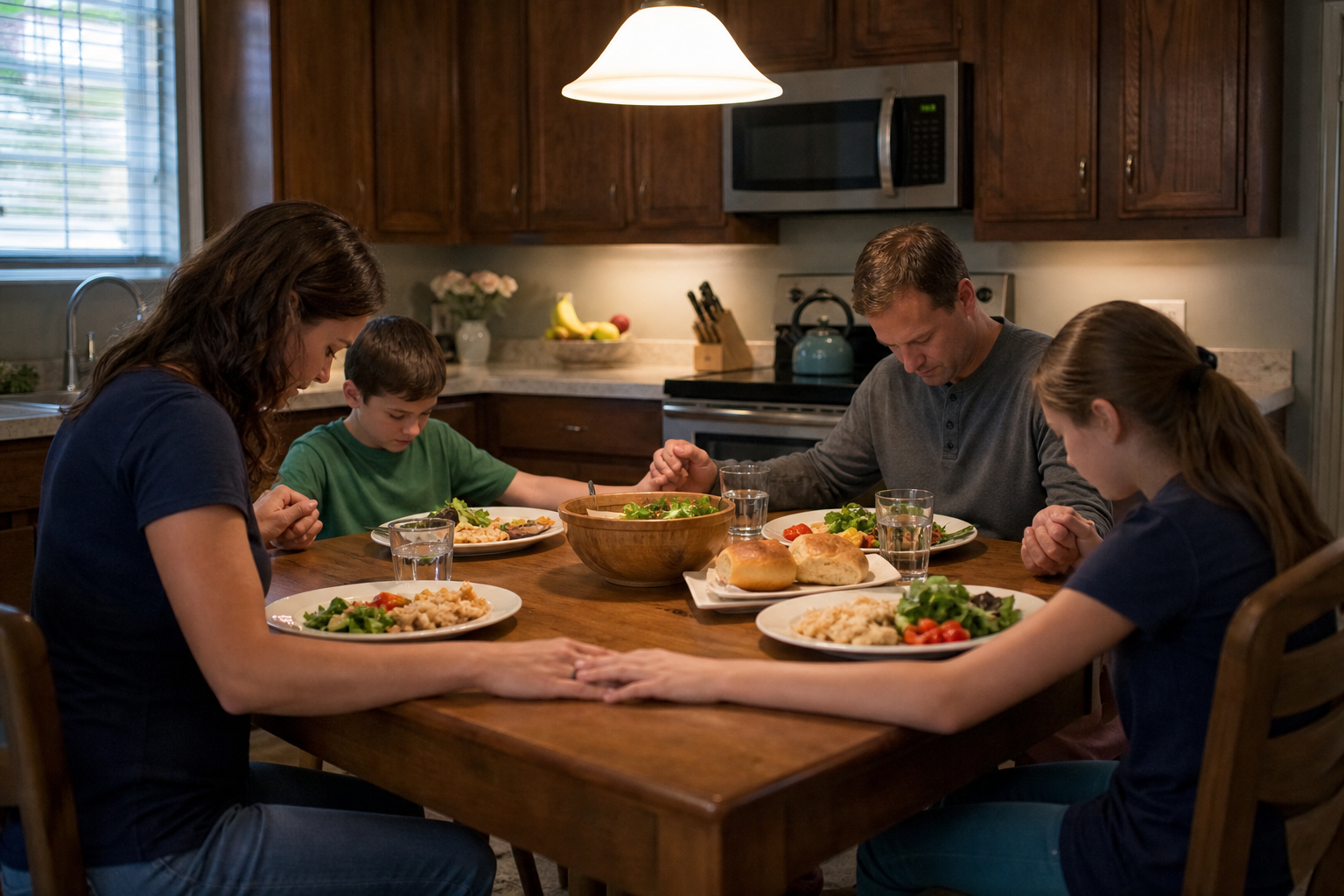
Most believers pray alone and in public, and almost never in the room in between. The in between room is the household, and it may be the one that forms people most.
The household is the room between private and public prayer. Keep it short, keep it real, and do not clean it up.
Deuteronomy 6:6 says these words shall be in your heart, and you shall teach them diligently to your children, and talk of them when you sit in your house, when you walk by the way, when you lie down and when you rise up. That is not a curriculum. That is a description of ordinary hours.
The obstacle is almost always self consciousness. Praying out loud in front of people who know exactly what you are like is uniquely exposing. A spouse has heard you at your worst. Children notice everything.
So start small enough that it is not a production.
Pray one sentence at meals, and let it be about something real from that day rather than a formula. Children learn more from hearing you mention an actual worry to God than from any phrasing you could teach them.
Pray at the door. Thirty seconds before someone leaves for school or work. Name what they are walking into.
Let them hear you ask, and let them hear you thank. Households that only ever hear requests learn that God is for emergencies. Say the good things out loud too, and name them as from him.
And do not clean it up. If a prayer is honest and a little awkward, that is the version that teaches. Polished prayers teach children that prayer is a performance they are not yet qualified for.
The house is where faith is either made ordinary or made foreign. Ordinary is what you want.