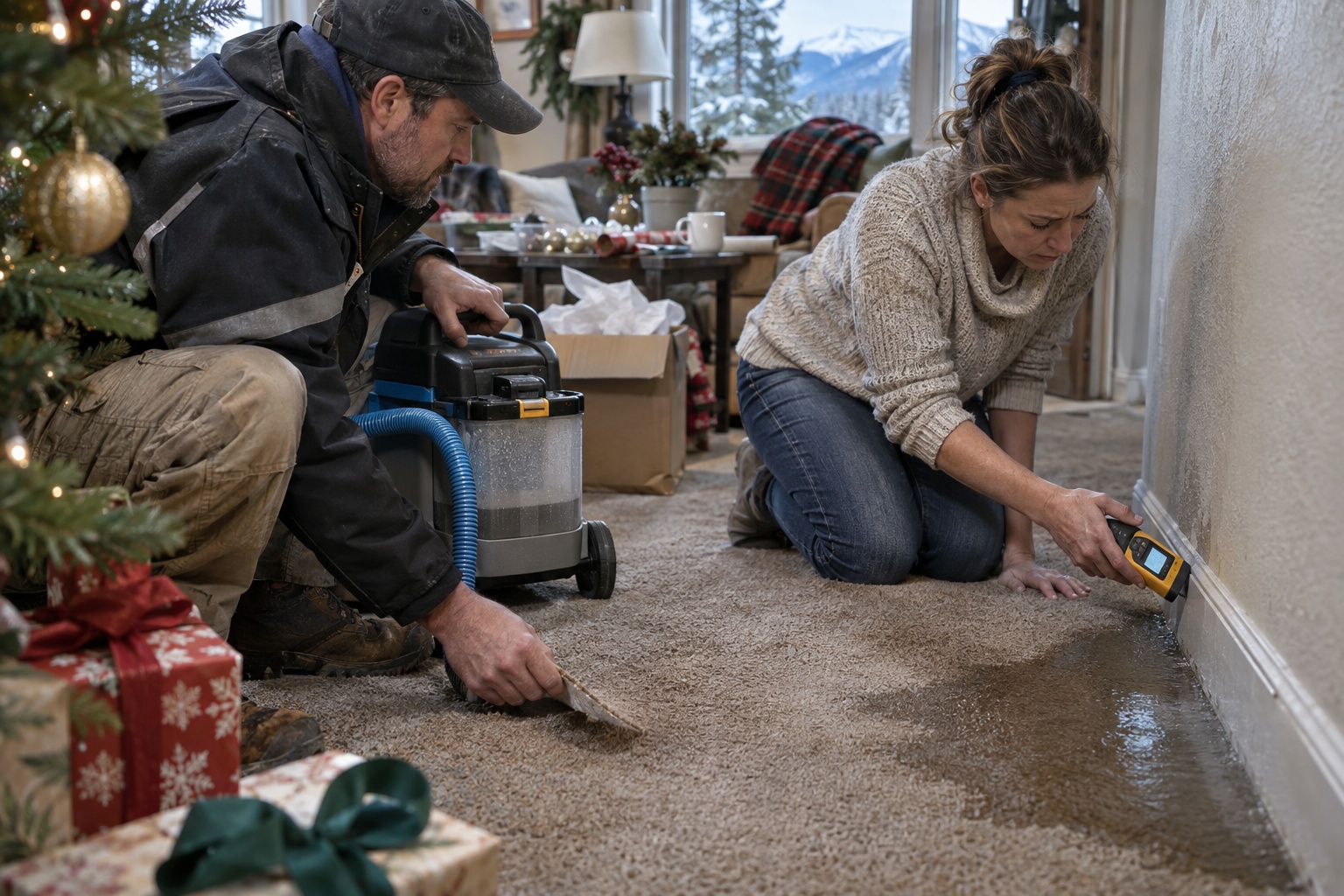
The leak usually shows up at the worst possible time in Colorado Springs. You are making up guest beds, the overnight low drops into the teens, and suddenly there is water spreading from a laundry room, ceiling line, or baseboard. In that moment, the real question is not just how to clean it up. It is whether you need emergency water removal Colorado Springs service right now, or whether controlled drying is enough.
If you have standing water, carpet that squishes underfoot, more than one affected room, or moisture that reached the pad, subfloor, or walls, you likely need emergency water removal Colorado Springs service, not just surface drying. If the leak is small, contained, and only dampened a hard surface or a very limited area that can be dried completely within hours, drying alone may be enough.
How do I know if my Colorado Springs leak needs emergency water removal or just drying?
You can usually make the first call in 5 to 10 minutes by checking four things: water depth, carpet saturation, room count, and how far the moisture traveled below the surface. If water is pooled, if carpet and pad are saturated, if damage crosses into a second room or hallway, or if drywall and subfloor are wet, treat it as an extraction job first.
Here is the practical line I want homeowners to use:
- Drying alone may be enough if the leak was brief, the water stayed on a non-porous surface, the affected area is small, and nothing is squishing, swelling, or wicking up the wall.
- Emergency water removal is usually necessary if you can see standing water, feel water pushing up through carpet, hear a wet slap under flooring, or find moisture spreading into trim, drywall, cabinets, or the room next door.
Most people wait too long because the top looks better than the bottom. I see that a lot after holiday leaks. The towel work looks decent, but the pad underneath is still soaked 12 hours later.
5 minute decision checklist
- Standing water is visible, even if it is less than 1/4 inch.
- Carpet feels squishy, dark, heavy, or wet beyond the obvious spot.
- Water reached 2 or more connected spaces, such as a bedroom and hall.
- Baseboards, drywall edges, cabinets, or door trim are wet.
- The source was a burst or freeze-related pipe, not a simple spill.
- You cannot confirm the pad and subfloor are dry underneath.
What are the emergency thresholds I can actually see right away?
The fastest way to sort this out is to use visible thresholds, not guesswork. If any one of these thresholds is met, emergency water removal Colorado Springs service is the safer call.
| What you observe | More likely drying only | More likely extraction needed |
|---|---|---|
| Standing water depth | No pooling, just a damp surface | Any pooling, especially 1/8 inch to 1/4 inch or more |
| Carpet condition | Top fibers damp in one small spot | Carpet is soaked, heavy, or squishes when stepped on |
| Affected area | One small contained area | Two rooms, a hallway, or water traveling under walls |
| What is wet underneath | Surface only | Pad, subfloor, drywall edge, trim, cabinets, or insulation |
A weak response looks like this: mop the floor, set one box fan in the doorway, and assume the rest will dry by morning. A stronger response is: stop the source, document the damage, check adjoining rooms, pull back a carpet corner if accessible, and decide based on what is wet underneath, not just what looks wet on top.
What should I do in the first hour after a holiday leak?
The first hour matters because water migration is still active. Your priorities are to stop the source, keep people safe, document what happened, and prevent more absorption into finish materials.
- Shut off the water source if you can do it safely. If it is a burst supply line, use the local fixture shutoff or the main.
- Cut power to affected areas if water is near outlets, cords, or appliances.
- Take clear photos and short video of the source, affected rooms, flooring, walls, furniture, and any visible pooling.
- Move dry items out of the path, especially rugs, gifts, boxes, and anything sitting directly on carpet.
- Blot or contain surface water with towels only if it is safe and limited. Do not assume towel drying solves saturation below the surface.
- Check the next room and the backside of shared walls. Water often runs farther than people expect.
If the source may involve contaminated water, skip DIY cleanup and read the difference on this Colorado Springs sewage cleanup page. Clean water from a pipe break is one thing. Category 3 water is another problem entirely.
In Colorado Springs, a freeze break often reveals itself after temperatures rebound a bit and water starts moving again. We see this around holiday travel, especially when homes in Briargate, Rockrimmon, and the north side sit empty overnight, then warm back up with normal use the next morning.
Why do freeze related pipe breaks raise the urgency?
Cold-weather pipe breaks are more urgent because the leak may have started behind a wall, in a crawlspace, or above a ceiling before anyone notices the visible damage. That means by the time water shows up in the living area, materials behind the scenes may already be saturated.
Freeze-related leaks also tend to run under pressure, which can add volume fast. A slow appliance drip and a split copper or supply line are not the same event. The pressure difference changes how quickly carpet pad, OSB subfloor, lower drywall, and insulation get loaded with water.
The Federal Emergency Management Agency lists burst pipes among common cold-weather home damage issues, and the Ready.gov winter guidance stresses acting quickly to shut off water and protect the property. That lines up with what we see locally. Overnight temperatures in the Pikes Peak region can drop fast enough that a pipe issue goes from hidden to obvious between bedtime and breakfast.
My plain advice is this. If the leak showed up after a freeze night, I would lean toward extraction sooner, not later, because the visible spot is rarely the full footprint.
Common mistake: judging the job by the dry-looking top layer
Homeowners often decide the situation is minor because the carpet surface starts to look normal after towels and airflow. The problem is the pad underneath can stay saturated, and moisture can wick 6 to 12 inches up drywall even after the floor looks better. Visible improvement is not the same as a dry assembly.
Why can hidden moisture under carpet outlast visible cleanup?
Carpet can fool you because the fibers on top release moisture faster than the pad and subfloor below. That means the room may look better while the materials most likely to hold moisture stay wet for much longer.
According to the IICRC, proper water damage restoration depends on identifying affected materials and drying the structure, not just removing visible water. The EPA also warns that lingering moisture can support mold growth if wet materials are not dried promptly and completely. Those are broad standards, but they matter on the ground in a Colorado Springs house with carpet over pad and wood subfloor.
Here is where I want people to slow down and think. If the carpet got wet enough to change color across a wide area, or your foot pushes moisture outward when you step, the issue is not the carpet face. It is the system under it.
That is why emergency water removal Colorado Springs work often starts with extraction, moisture mapping, and targeted drying setup. Not because every leak needs demolition, but because hidden moisture changes the plan. If you want a deeper look at what repairs can follow after dry-out, this page on options for repairing water damage helps explain the next stage.
Cassie Strong's Insights
I am usually talking to people while they are still standing in wet socks, trying to decide if they are overreacting. My rule is simple. If water got below the surface, I treat that seriously even if the room does not look terrible yet. Around the holidays, people want a fast answer because guests are coming, and I understand that pressure. What I do not want is for you to spend the evening drying what you can see while moisture keeps sitting in the pad, under the baseboard, or inside the wall. I cannot promise every wet carpet can be saved, and I will tell you plainly when another specialist or testing step is needed. But if you call early, we can usually make a much cleaner, more controlled plan than if everyone waits until the smell shows up or the drywall edge starts to swell.
How fast should drying start, and how long is too long to wait?
Drying should start the same day, and extraction should start as soon as you know water moved below the surface. Waiting overnight is where small losses often turn into larger restoration jobs.
As a practical window:
- Within the first 1 hour: stop the source, document, protect contents, and assess spread.
- Within 2 to 4 hours: decide whether this is surface drying or extraction plus structural drying.
- By 24 hours: lingering wet pad, trim, drywall edge, or subfloor is a bad sign.
- At 48 hours and beyond: odor, swelling, and microbial concerns become more likely if materials remain wet.
No honest restorer should promise what insurance will cover before the facts are reviewed, and no one should promise every material can be kept. What I can say is that quicker, documented action gives you a better chance of limiting spread and making the scope clearer.
Frequently Asked Questions
Can I just run fans overnight and decide tomorrow?
If the leak only dampened a small hard-surface area and nothing underneath is wet, that may be reasonable. If carpet pad, subfloor, drywall, or multiple rooms are involved, waiting until tomorrow can let moisture spread and makes emergency water removal Colorado Springs service more likely, not less.
Does a small amount of standing water still count as an emergency?
It can. Even 1/8 inch of standing water across carpet or along a wall base can mean more water has already moved into the pad, trim, or adjacent room. The depth matters, but the material it touched matters more.
What if the visible water is gone but the room still smells damp?
A damp or musty smell after cleanup often points to retained moisture below the surface. That is common under carpet, inside lower drywall, and around baseboards. At that point, a moisture inspection and a professional drying plan are usually more useful than adding another fan.
Need help deciding between drying and extraction?
If you are dealing with a holiday leak, a burst pipe, or hidden moisture and need someone to take the emergency water removal Colorado Springs decision off your plate, Executive Pro Dry can handle the assessment, extraction, and dry-out steps for you.
Get help now from Executive Pro Dry